If you’re a therapist considering leaving insurance panels—or starting a practice without signing contracts with insurance companies—you may be wondering how to become an out-of-network therapist.
The good news is that being out of network generally does not mean you cannot work with clients who have health insurance.
Instead, an out-of-network practice typically means you do not have a contractual in-network agreement with a particular insurance plan. Depending on the client’s plan, the client may still have out-of-network benefits that allow them to seek reimbursement for eligible therapy services.
Quick answer: To become an out-of-network therapist, you generally do not need to join an insurance network. Instead, you establish your private-pay practice, maintain the professional and billing credentials required for your practice, clearly communicate your fees and network status, provide appropriate documentation such as superbills when applicable, and help clients understand how they can verify and use their out-of-network benefits.
The exact administrative requirements vary by state, profession, payer, and practice model.
What Does It Mean to Be an Out-of-Network Therapist?
An out-of-network therapist is a therapist who does not have an in-network contract with a particular insurance company or health plan.
That is different from saying the therapist does not accept insurance at all.
A therapist can be:
- In network with one insurer
- Out of network with another
- Completely self-pay
- Out of network but willing to provide superbills
- Out of network while allowing clients to submit their own claims
For example, a therapist might charge a client directly for a therapy session and provide a superbill that the client can submit to their insurance company if their plan offers out-of-network mental health benefits.
Whether the insurer reimburses the client—and how much—is determined by the client’s plan and the claim.
For a patient-facing explanation, see ++What Is an Out-of-Network Provider?++.
Do You Have to “Become” an Out-of-Network Therapist?
Not usually in the same way you become an in-network provider.
The important distinction is:
In-network: You enter into a contractual relationship with a payer.
Out-of-network: You generally do not enter into that payer’s in-network contract.
That means there may not be a universal application called an “out-of-network therapist credentialing application.”
However, being out of network does not mean you can ignore normal professional, business, documentation, or billing requirements.
Your practice still needs an appropriate foundation.
How to Become an Out-of-Network Therapist
Here is a practical step-by-step process.
Step 1: Decide What “Out of Network” Means for Your Practice
First, decide whether you want to:
- Leave all insurance panels
- Remain in network with some insurers
- Work exclusively with private-pay clients
- Accept out-of-network clients who seek reimbursement
- Provide superbills
- Submit claims on behalf of clients when appropriate
These are different business models.
For example:
Model A: Private pay only
The client pays your full fee and you do not participate in the insurance reimbursement process.
Model B: Out of network + superbills
The client pays you, and you provide documentation that the client can submit to their insurer.
Model C: Hybrid
You remain in network with selected plans while operating out of network for others.
There is no single “best” model. The right approach depends on your practice, client population, financial goals, and administrative preferences.
Step 2: Make Sure Your Professional Credentials Are in Order
Before thinking about insurance reimbursement, make sure your underlying professional and business setup is appropriate.
Depending on your profession and location, this may include:
- An active professional license
- Appropriate business registration
- NPI
- Tax identification information
- Professional liability coverage
- A business bank account
- Appropriate client agreements
- Privacy and security procedures
- A compliant recordkeeping system
- Telehealth requirements, where applicable
The exact requirements vary by state and profession.
For information about the National Provider Identifier, see the ++CMS NPI Standard++.
Step 3: Set Your Private-Pay Fee
One of the biggest advantages of an out-of-network practice is greater control over your fee structure.
Instead of accepting a contracted reimbursement rate from an insurance company, you can establish your own standard fee.
For example:
Standard therapy session: $175
That does not mean the client’s insurer will reimburse $175.
If the client has out-of-network benefits, the insurer may calculate reimbursement using its own allowed amount and the patient’s plan rules.
This distinction should be explained clearly to clients.
Step 4: Check Whether You Are Actually Out of Network
Network status is payer- and plan-specific.
You might be out of network with one insurer but in network with another.
If you are leaving an insurance panel, confirm the termination process with that payer rather than simply assuming your status changes immediately.
Pay attention to:
- Contract termination requirements
- Notice periods
- Effective termination dates
- Existing authorizations
- Claims for dates of service before termination
- Continuity-of-care arrangements, if applicable
- Any contractual obligations
If you are considering leaving a network, review your contract and obtain professional advice when necessary.
Step 5: Tell Clients Clearly That You Are Out of Network
Your website, intake materials, and financial policies should make your network status easy to understand.
Avoid language such as:
“We accept insurance.”
That statement can be misleading if you do not participate in the client’s insurance network.
Instead, you might explain:
We are an out-of-network provider. We do not bill most insurance plans directly. If your plan includes out-of-network mental health benefits, you may be eligible for reimbursement. We can provide documentation for you to submit to your insurer. Please verify your benefits directly with your insurance company before beginning treatment.
This is much clearer.
Step 6: Help Clients Verify Their Out-of-Network Benefits
You don’t control the client’s insurance benefits.
The client should contact their insurance company and ask questions such as:
- Do I have out-of-network mental health benefits?
- Is outpatient psychotherapy covered out of network?
- What is my out-of-network deductible?
- How much of the deductible have I met?
- What is my coinsurance?
- Does the plan reimburse based on an allowed amount?
- Is authorization required?
- Do I need a referral?
- What documentation is required?
- Where do I submit an out-of-network claim?
- How long do claims typically take to process?
This helps prevent misunderstandings about reimbursement.
A therapist should avoid promising that a client will receive a specific reimbursement amount unless the information has been verified and is actually within the therapist’s control.
Step 7: Create a Clear Out-of-Network Financial Policy
Your financial policy should explain how payment works.
Consider addressing:
- Your standard fee
- Payment due date
- Accepted payment methods
- Cancellation policy
- Whether you provide superbills
- Whether you submit claims
- Who is responsible for insurance verification
- Who is responsible for claim submission
- What happens if insurance does not reimburse
- How refunds or credits are handled, if applicable
The policy should make clear that insurance reimbursement is not the same thing as payment to the therapist.
For example:
The client is responsible for payment of the therapist’s fee regardless of whether their insurance company subsequently reimburses them.
Have your attorney or appropriate professional advisor review your financial policies when needed.
Step 8: Set Up a Superbill Workflow
For many out-of-network therapists, the superbill is an important part of the administrative workflow.
A superbill is a detailed document that can provide information a patient may need when requesting reimbursement from their insurer.
It may contain information such as:
- Patient information
- Therapist information
- NPI
- Date of service
- Service information
- Diagnosis information, when applicable
- Amount charged
- Amount paid
- Provider signature or other applicable information
The exact information required can vary by payer.
Learn more:
++How to Create a Superbill for Therapy++
++Mental Health Superbill Template++
Step 9: Understand How Clients Get Reimbursed
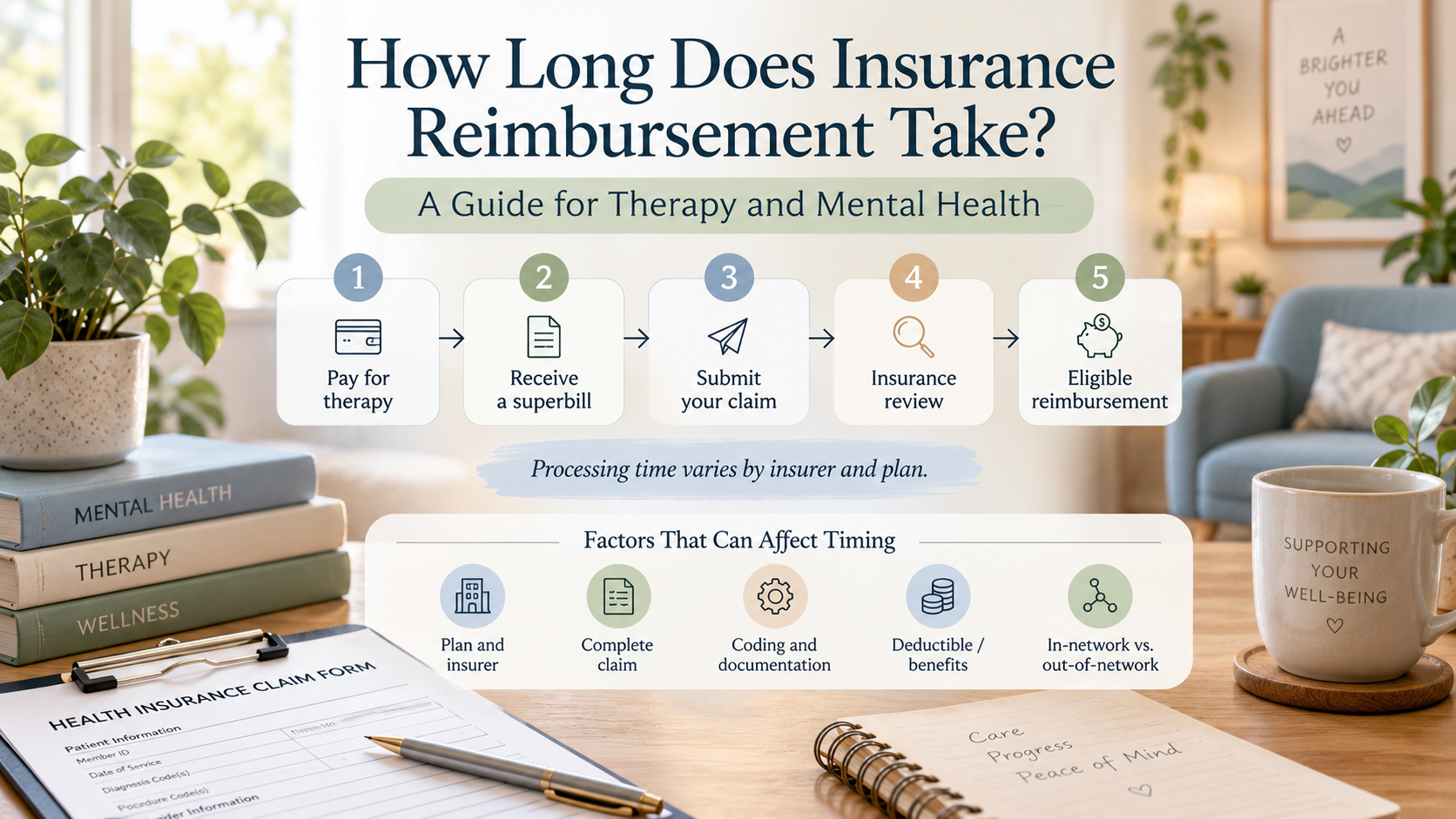
A typical out-of-network workflow may look like this:
Therapy session
↓
Client pays therapist
↓
Therapist provides superbill or other documentation
↓
Client submits claim to insurer
↓
Insurer processes claim
↓
Client receives EOB
↓
Insurer reimburses eligible amount, if applicable
The actual workflow can differ.
Some practices may submit claims electronically on behalf of clients. Some insurers may require the patient to submit the claim themselves.
Your practice should communicate which process you support.
For a deeper look at the reimbursement process, see ++Superbill Reimbursement++.
Step 10: Understand the Difference Between Your Fee and Insurance Reimbursement
This is one of the most important concepts for an out-of-network therapist.
Suppose you charge:
$200 per session
Your client’s insurance plan might use an allowed amount of:
$150
If the plan reimburses a percentage of that applicable amount after deductible requirements are considered, the client’s reimbursement could be substantially less than your $200 fee.
The client may therefore have a remaining out-of-pocket amount.
The exact calculation depends on the insurance plan.
The key principle
Your fee is not necessarily the amount the insurer uses to calculate reimbursement.
That is why therapists should avoid telling clients:
“Your insurance will pay 80% of my fee.”
A more accurate statement is:
“Your plan may provide out-of-network reimbursement. Please verify your benefits and reimbursement calculation directly with your insurer.”
Step 11: Decide Whether You Will File Claims for Clients
An out-of-network practice can choose how involved it wants to be in the insurance process.
Option 1: Client submits claims
You provide the necessary documentation, and the client handles the claim.
Advantages:
- Less administrative work
- Clear separation between clinical services and insurance administration
- No need to manage every payer’s claim portal
Disadvantages:
- More work for clients
- Clients may have questions about claim status
Option 2: Practice submits claims
Your practice submits claims on behalf of clients where appropriate.
Advantages:
- More convenient for clients
- Greater visibility into claim status
Disadvantages:
- More administrative work
- More payer-specific requirements to manage
- Greater need for billing processes and controls
Option 3: Use billing software or a billing service
Technology or a third-party billing workflow can help automate or centralize some administrative tasks.
The best choice depends on your volume and practice model.
Step 12: Create a Process for Denials and Reimbursement Problems
Out-of-network claims can sometimes be denied, delayed, or processed differently than expected.
Common issues can include:
- Missing information
- Incorrect patient information
- Incorrect provider information
- Eligibility problems
- Deductible application
- Service coverage issues
- Authorization requirements
- Network-status misunderstandings
- Payer processing errors
If a claim is denied, review the explanation from the insurer and determine whether additional documentation, a corrected claim, or an appeal may be appropriate.
Do not assume every denial is final.
For claim-submission guidance, see ++How to Submit Therapy Claims to Insurance++.
Do Out-of-Network Therapists Need to Be Credentialed?
This is an important distinction.
Out-of-network does not necessarily mean “no credentials are required.”
A therapist still needs the professional credentials and identifiers appropriate to practice and to support billing documentation.
However, being out of network generally means you are not participating in a particular payer’s contracted provider network.
A payer may have additional requirements if you submit claims to it or if you want clients to receive reimbursement.
Because requirements can vary, therapists should verify the relevant payer’s current instructions rather than assuming that all insurers use the same process.
Do Out-of-Network Therapists Need an NPI?
Healthcare providers who are subject to HIPAA administrative simplification requirements may need an NPI for applicable transactions.
An NPI is a unique identifier for covered healthcare providers.
CMS maintains information about the ++National Provider Identifier Standard++.
Having an NPI does not mean that a therapist is in network with an insurer.
These are separate concepts.
Can You Be Out of Network With Some Insurance Companies and In Network With Others?
Yes.
Network participation is not necessarily an all-or-nothing decision.
For example:
| Insurance company | Therapist status |
| Plan A | In network |
| Plan B | Out of network |
| Plan C | Out of network |
| Self-pay clients | Accepted |
A therapist might intentionally use a hybrid model to balance accessibility, reimbursement, and practice autonomy.
What Are the Benefits of Being an Out-of-Network Therapist?
There are several reasons therapists may choose an out-of-network model.
More control over fees
You are generally not bound by the reimbursement rate in an in-network contract.
Greater practice autonomy
You may have more flexibility around:
- Session structure
- Scheduling
- Client population
- Practice model
- Fees
Less payer administration
Depending on your workflow, you may have fewer payer contracts, credentialing processes, and network-specific requirements to manage.
Ability to focus on a specialty
Some therapists choose an out-of-network model because they provide specialized services for which clients may be willing to pay directly.
Potentially simpler financial relationship
The therapist can collect the practice’s fee directly while the client handles reimbursement separately.
What Are the Downsides of Being Out of Network?
An out-of-network model also has tradeoffs.
Clients may have higher upfront costs
Clients typically pay the therapist directly, depending on the practice’s policies.
Reimbursement is not guaranteed
A client’s insurance may provide no out-of-network benefit, or reimbursement may be lower than expected.
Some clients may choose in-network providers
Clients who prioritize lower upfront costs may prefer a therapist in their insurance network.
Superbills and documentation still take time
Even when the client submits the claim, the therapist may need to produce accurate documentation.
Clients may ask for help with insurance
Even if your practice does not submit claims, clients may still have questions about reimbursement.
How Can an Out-of-Network Therapist Make the Process Easier for Clients?
You don’t have to become the client’s insurance company.
Instead, make the process predictable.
Consider providing:
A benefits-verification checklist
Give clients a list of questions to ask their insurer.
A clear financial policy
Explain exactly what the client pays your practice.
Consistent superbills
Create a repeatable process for generating documentation.
Clear reimbursement expectations
Explain that out-of-network reimbursement depends on the client’s insurance plan.
Claim-submission instructions
Tell clients where they can obtain their insurer’s current claim instructions.
A reimbursement FAQ
Answer common questions before they become administrative tasks.
How Can Out-of-Network Therapists Automate Superbills?
If you see only a few clients each week, manually creating superbills may be manageable.
As your practice grows, repetitive administrative work can become a significant burden.
A billing workflow can help centralize:
- Client information
- Dates of service
- Charges
- Payment records
- Provider information
- Superbill generation
- Claim documentation
- Reimbursement tracking
The goal is not to automate clinical judgment.
The goal is to reduce repetitive administrative work.
That’s where platforms such as ++DeputyCare++ can fit into an out-of-network practice workflow.
Can AI Help an Out-of-Network Therapy Practice?
AI can potentially help with repetitive administrative workflows, including:
- Organizing billing information
- Identifying missing administrative data
- Drafting client-facing administrative messages
- Summarizing records
- Routing repetitive tasks
- Flagging potential workflow exceptions
- Supporting documentation workflows
However, AI should be implemented carefully in healthcare settings.
A practice should consider:
- What information is being processed
- Where the information is stored
- Who has access
- Security controls
- Vendor agreements
- Applicable privacy obligations
- Human review
Do not assume that a particular AI product is automatically HIPAA compliant simply because it is marketed for healthcare.
For more on this topic, see ++How AI Is Transforming Therapy Superbill and Insurance Workflows++.
Out-of-Network Therapist vs. Private-Pay Therapist
These terms are sometimes used interchangeably, but they are not identical.
| Model | Insurance relationship |
| In-network therapist | Has a payer contract |
| Out-of-network therapist | Does not have an in-network contract with that payer |
| Private-pay therapist | Client pays directly; insurance may or may not be involved |
| Out-of-network + superbills | Client pays therapist and may seek insurer reimbursement |
An out-of-network therapist can therefore still have clients who use their insurance benefits.
Should You Become an Out-of-Network Therapist?
There is no universal answer.
An out-of-network model may be attractive if you want:
- Greater control over your fees
- More practice autonomy
- A specialized practice
- Less dependence on payer contracts
- A simpler relationship between your practice and client payment
It may be less attractive if your target clients strongly depend on in-network coverage or if you want insurance companies to handle more of the payment process.
Consider the economics carefully.
Compare:
Expected private-pay fee
vs.
Expected in-network reimbursement
vs.
Administrative time
vs.
Client acquisition impact
vs.
Client affordability
The highest reimbursement per session is not necessarily the most profitable practice model if it significantly reduces your ability to attract or retain clients.
A Simple Out-of-Network Therapist Setup Checklist
Before launching your out-of-network model, consider whether you have:
- Active professional license
- Appropriate business structure
- NPI, when applicable
- Tax and business information
- Professional liability coverage
- Practice management system
- Standard fee schedule
- Financial policy
- Cancellation policy
- Network-status language
- Client insurance-verification instructions
- Superbill workflow
- Claim documentation process
- Payment collection process
- Reimbursement FAQ
- Denial/claim follow-up process
- Secure records and administrative workflows
Frequently Asked Questions
How does a therapist become an out-of-network provider?
A therapist generally becomes out of network with a payer by not participating in that payer’s contracted provider network. The therapist can operate a private-pay practice and, where appropriate, provide documentation such as superbills so clients can seek reimbursement under their own out-of-network benefits.
Do I need to apply to become an out-of-network therapist?
There is generally not one universal application to become “out of network.” However, individual payers may have requirements for providers who submit claims or interact with their systems. Verify the current requirements for each payer involved.
Can I accept insurance without being in network?
Yes, but “accept insurance” can mean different things. An out-of-network therapist may provide documentation for a client to submit to insurance, while another practice may submit claims directly. Clearly explain your process to clients.
Can an out-of-network therapist provide a superbill?
Yes. Many out-of-network therapists provide superbills or similar documentation to help clients request reimbursement when their insurance plan offers out-of-network benefits.
Will insurance reimburse my clients if I am out of network?
It depends on the client’s specific insurance plan and the claim. Some plans provide out-of-network benefits; others may not.
Can I be in network with one insurance company and out of network with another?
Yes. Network participation is generally specific to the payer and applicable plan or contract.
Do I need an NPI to be an out-of-network therapist?
NPI requirements depend on applicable healthcare administrative rules and transactions. An NPI is separate from insurance network participation. Check CMS guidance and the requirements applicable to your practice.
Should an out-of-network therapist file insurance claims?
It depends on your business model. You can choose to have clients submit their own claims, submit claims on their behalf where appropriate, or use billing support.
How much should an out-of-network therapist charge?
There is no universal out-of-network fee. Consider your market, specialty, experience, operating costs, client demand, and desired practice economics. Do not set your fee based solely on what you expect an insurer to reimburse.
Is being an out-of-network therapist worth it?
It can be, particularly for therapists who value fee and practice autonomy. But the model can also reduce accessibility for clients and shift more payment and reimbursement responsibility to them.
Final Takeaway
Becoming an out-of-network therapist is less about obtaining a special “out-of-network” credential and more about choosing a practice model that does not rely on in-network payer contracts.
A successful out-of-network practice typically needs:
Professional credentials → clear fees → transparent financial policies → accurate documentation → superbill/claim workflow → client benefits education → efficient administration
The most important thing is to be precise about what you promise.
You can tell a client:
“I am an out-of-network provider, and I can provide documentation for you to request reimbursement.”
You generally should not promise:
“Your insurance will reimburse 80% of my fee.”
The first describes your practice’s process. The second makes a claim about an insurance plan that you may not control.
For therapists moving toward an out-of-network model, getting the administrative workflow right from the beginning can make the practice much easier to operate as it grows.
Related DeputyCare Resources
- ++What Is an Out-of-Network Provider?++
- ++What Is Out-of-Network Therapy?++
- ++Is My Therapist In or Out of Network?++
- ++Superbill for Therapists++
- ++Mental Health Superbill Template++
- ++Superbill Reimbursement++
- ++How to Submit Therapy Claims to Insurance++
- ++How Long Does Insurance Reimbursement Take?++
- ++How Much Does Insurance Pay for Therapy?++
- ++Why Don’t Therapists Take Insurance?++
- ++Mental Health Billing Software++
- ++DeputyCare++