Does Health Insurance Cover Therapy? What Your Plan May Pay
Yes, health insurance may cover therapy, but your actual coverage and out-of-pocket cost depend on your specific health plan, the therapist you see, and whether the services are in network or out of network.
Your insurance may cover some or all of an eligible therapy service after applying your plan’s deductible, copay, coinsurance, or other requirements.
If you see an out-of-network therapist, your plan may still provide reimbursement if your policy includes out-of-network mental health benefits. In that situation, you may pay the therapist directly and submit a superbill or other required documentation to your insurance company.
The important point is this:
Having health insurance does not necessarily mean therapy is free. It means your plan may pay part of the cost according to its specific benefits.
This guide explains how therapy insurance coverage works, what to ask your insurer, how out-of-network reimbursement works, and how to estimate what you may actually pay.
Does Health Insurance Cover Therapy?
Many health insurance plans cover therapy and other mental health services, but coverage varies by plan.
Your plan may cover therapy through:
- In-network mental health benefits
- Out-of-network mental health benefits
- Copays
- Coinsurance
- Deductible-based coverage
Your coverage may also depend on the type of service, provider, and requirements of your particular plan.
For example, one insurance plan might have a relatively low copay for an in-network therapy appointment.
Another plan might require you to meet a deductible first.
A plan with out-of-network benefits might allow you to see a therapist outside the network and request reimbursement after paying the therapist yourself.
For general health insurance information, visit ++HealthCare.gov++.
How Much Does Health Insurance Cover for Therapy?
There is no single amount that health insurance covers for therapy.
The amount you pay can depend on:
| Factor | Why it matters |
| Network status | In-network and out-of-network benefits can differ |
| Deductible | You may pay eligible costs before the plan begins paying according to its terms |
| Copay | You may owe a fixed amount for a covered service |
| Coinsurance | You may owe a percentage of an eligible amount |
| Allowed amount | The insurer may calculate benefits using an allowed amount rather than the therapist’s full fee |
| Coverage | Some services may be covered while others may not be |
| Authorization | Some plans may have authorization requirements |
| Provider requirements | Coverage can depend on provider and service eligibility |
This is why asking, “Does my insurance cover therapy?” is only the first question.
The more useful question is:
“How much will I actually pay for a therapy session under my plan?”
How Can I Find Out If My Health Insurance Covers Therapy?
The best way is to check your plan documents or contact your insurance company.
Ask your insurer these questions before beginning treatment:
1. Is outpatient therapy covered?
Ask specifically about the type of mental health care you’re considering.
2. Is my therapist in network?
Don’t assume a therapist is in network because their website mentions insurance.
Network participation can depend on the specific insurance plan.
3. Does my plan cover out-of-network therapy?
This is especially important if you’ve found a therapist who does not participate in your insurance network.
4. What is my therapy copay?
Ask whether a fixed copay applies.
5. What is my deductible?
Find out whether your deductible applies to mental health services and whether you have already met it.
6. What is my coinsurance?
If coinsurance applies, ask what percentage you are responsible for and what amount that percentage is based on.
7. Do I need prior authorization?
Some plans may have authorization or other utilization-management requirements.
8. Do I need a referral?
Some plan structures may require one.
9. Do I have a claim filing deadline?
This is especially important if you’re responsible for submitting out-of-network claims yourself.
10. How do I submit an out-of-network claim?
Ask whether you can submit claims online, through an app, by mail, or through another method.
Write down the answers.
Insurance benefits can be complicated, and having a record of what your insurer tells you can make follow-up easier.
Does Insurance Cover Out-of-Network Therapy?
It may.
Some health insurance plans include out-of-network mental health benefits.
If yours does, you may be able to see a therapist who isn’t contracted with your insurance company and then request reimbursement for eligible services.
A common process looks like this:
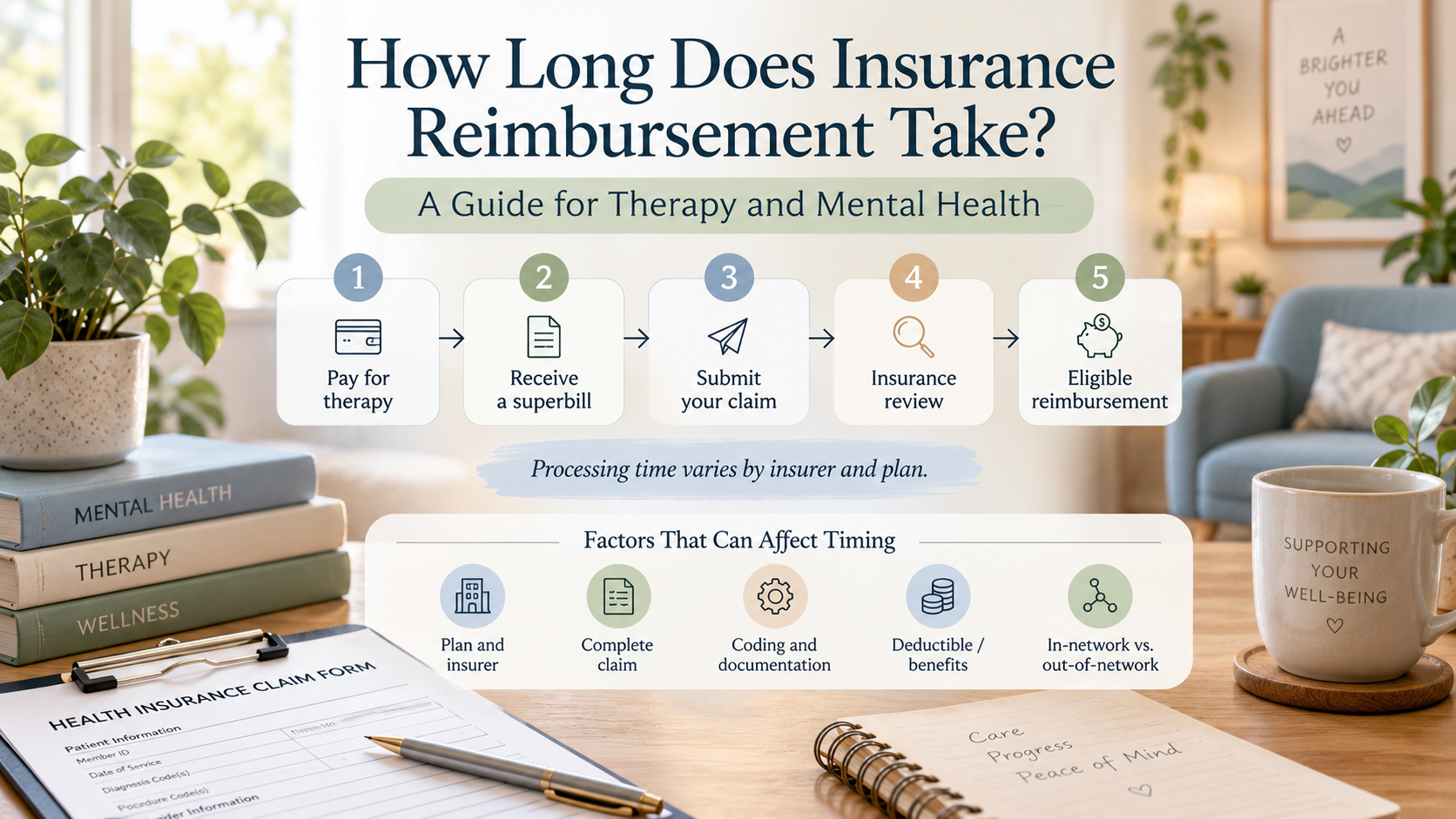
Find therapist → Confirm out-of-network benefits → Pay therapist → Receive superbill → Submit claim → Insurance processes claim → Review EOB → Receive reimbursement, if eligible
The reimbursement amount depends on your plan.
Some plans may reimburse a percentage of an allowed amount after the applicable deductible has been satisfied.
Other plans may have different rules.
Learn more in ++What Is an Out-of-Network Provider?++.
What Is an Out-of-Network Therapist?
An out-of-network therapist generally does not have a contracted provider agreement with your health insurance plan.
That does not automatically mean your insurance won’t pay anything.
Your plan might offer out-of-network benefits.
For example:
Therapist’s fee: $175
Insurance allowed amount: $120
Plan reimbursement: 60% of allowed amount
Potential reimbursement: $72
Patient’s effective cost: $103
This is a hypothetical illustration only.
Your plan could use different amounts, percentages, deductibles, or rules.
For a detailed explanation of the reimbursement process, see ++Superbill Reimbursement: How Out-of-Network Therapy Works++.
Does Insurance Pay for Therapy Before You Meet Your Deductible?
It depends on your plan.
A deductible is generally the amount you pay for covered healthcare services before your plan begins paying according to its applicable terms.
Suppose your plan has:
- $1,500 out-of-network deductible
- 60% coinsurance after the deductible
If you haven’t met the applicable deductible, an eligible therapy claim could be applied toward that deductible rather than resulting in an immediate reimbursement payment.
Once the deductible is satisfied, your plan may begin paying according to the applicable coinsurance.
Your plan may have different rules, so check your benefits.
Does Insurance Pay for Therapy With a Copay?
It can.
Some plans use a copay for certain covered mental health services.
For example, a plan might require a fixed copay for an eligible in-network outpatient therapy appointment.
The exact amount can vary.
Don’t assume the same copay applies to every therapist or every type of mental health service.
Your plan’s benefit documents or insurer can tell you which cost-sharing rules apply.
Does Insurance Pay for Therapy With Coinsurance?
It can.
Coinsurance generally means you pay a percentage of an eligible healthcare cost after applicable deductible requirements have been met.
For example, a plan might cover 70% of an applicable allowed amount while you are responsible for 30%.
But this does not necessarily mean:
Therapist’s fee × 30%
For out-of-network services, the insurer may first determine an allowed amount.
That’s why the therapist’s advertised fee and the insurance company’s reimbursement calculation can be very different.
What Is the Difference Between the Therapist’s Fee and the Insurance Allowed Amount?
This distinction is important when estimating therapy costs.
Suppose a therapist charges:
$200
Your insurer might determine an allowed amount of:
$130
If your plan reimburses 60% of the applicable allowed amount after your deductible, the calculation could look like:
$130 × 60% = $78
You paid the therapist $200.
The potential insurance reimbursement is $78.
Your effective cost would therefore be:
$200 − $78 = $122
Again, this is an example, not a standard reimbursement rate.
The actual calculation depends on your plan.
For more information, read ++How Much Does Insurance Pay for Therapy?++.
What Is a Superbill for Therapy?
A superbill is an itemized healthcare document that a therapist may provide to document services and billing information.
A superbill may include information such as:
- Patient name
- Provider name
- Practice information
- Provider NPI
- Date of service
- Service information
- Procedure code
- Diagnosis information, when applicable
- Amount charged
- Amount paid
- Other information required or useful for the claim
A superbill is commonly used to support an out-of-network insurance claim.
However:
A superbill does not guarantee insurance reimbursement.
Your insurer still determines whether the claim is eligible under your plan.
Learn more with the ++Mental Health Superbill Template++.
Is a Superbill the Same as an Insurance Claim?
No.
A superbill is documentation provided by the healthcare provider.
An insurance claim is the request submitted to an insurer for processing.
Depending on your insurance company’s process, you may need to submit a claim form together with the superbill.
That means receiving a superbill from your therapist does not necessarily mean your insurance company has received your claim.
If you’re responsible for filing the claim, confirm that it was successfully submitted.
See ++How to Submit Therapy Claims to Insurance++.
Does Insurance Cover Online Therapy?
It may.
Some insurance plans cover eligible telehealth or online mental health services, but coverage depends on the plan and applicable requirements.
Before choosing online therapy, ask your insurer:
- Is telehealth therapy covered?
- Is the therapist in network?
- Are out-of-network telehealth benefits available?
- Are there location requirements?
- Does the same cost-sharing apply?
- Are there authorization requirements?
Don’t assume that online therapy automatically has the same benefits as in-person therapy.
Does Insurance Cover Couples Therapy?
It depends on the plan and the service.
Insurance coverage may depend on whether the service is an eligible mental health benefit and how the service is billed and documented.
If you’re considering couples therapy, ask your insurer specifically whether the service is covered under your plan.
Don’t rely solely on a general answer that “mental health services are covered.”
Does Insurance Cover Cognitive Behavioral Therapy?
It may.
Cognitive behavioral therapy (CBT) is a type of psychotherapy, but whether a particular service is covered depends on the patient’s plan, provider, service, and applicable requirements.
If you’re specifically looking for CBT, ask your insurer whether the relevant outpatient mental health services are covered and ask your therapist how the service is billed.
Why Doesn’t My Therapist Accept Insurance?
A therapist may choose not to participate in insurance networks for several reasons.
These can include:
- Administrative workload
- Reimbursement rates
- Documentation requirements
- Claim management
- Practice model
- Provider availability
- Preference for private-pay care
A therapist not accepting your insurance does not necessarily mean your insurance provides no financial benefit.
If the therapist is out of network, check whether your plan offers out-of-network benefits.
Read ++Why Don’t Therapists Take Insurance?++.
Can You Use Insurance If Your Therapist Doesn’t Accept It?
Possibly.
This is where out-of-network benefits can matter.
For example:
- You choose a therapist who doesn’t participate in your insurance network.
- You confirm that your plan has out-of-network mental health benefits.
- You pay the therapist according to their fee schedule.
- The therapist provides a superbill.
- You submit the required claim documentation.
- Your insurance company processes the claim.
- You receive an EOB.
- Your insurer provides reimbursement if the claim is eligible.
This arrangement can give patients more therapist choices while still allowing them to use certain insurance benefits.
However, the financial outcome depends on the specific plan.
What Is an EOB?
An Explanation of Benefits (EOB) is a document from your insurance company explaining how a healthcare claim was processed.
An EOB may show:
- Provider charges
- Amount considered by the insurer
- Allowed amount
- Amount applied to your deductible
- Insurance payment
- Patient responsibility
- Claim adjustments
- Denial information
An EOB is generally not a bill.
If you submit out-of-network therapy claims, reviewing your EOB can help you understand whether the reimbursement matches what you expected.
What If My Therapy Claim Is Denied?
First, determine why.
Possible reasons include:
- Missing information
- Incorrect information
- Coverage limitations
- Deductible requirements
- Authorization requirements
- Eligibility issues
- Provider information problems
- Filing deadlines
- Other plan-specific requirements
Check the EOB or denial notice for an explanation.
If something appears incorrect, contact the insurer and ask what happened.
If appropriate, ask about correcting, reconsidering, or appealing the claim under your plan’s procedures.
Keep copies of all documentation.
How Long Does Insurance Take to Reimburse Therapy?
There is no universal reimbursement timeline.
Processing can depend on:
- How the claim was submitted
- Whether the claim was complete
- Whether additional information was requested
- The insurer’s processing procedures
- Whether the claim requires additional review
- Whether the claim was initially denied
If you submit an out-of-network claim, keep:
- Superbill
- Claim confirmation
- Claim number
- Submission date
- EOB
- Correspondence
- Payment records
For a detailed guide, see ++How Long Does Insurance Reimbursement Take?++.
How to Check Your Therapy Insurance Benefits
Use this five-step process before committing to ongoing therapy.
Step 1: Identify your plan
Have your insurance card and plan information available.
Step 2: Check the therapist’s network status
Confirm whether the specific therapist is in network.
Step 3: Check your benefits
Look for:
- Mental health benefits
- Deductible
- Copay
- Coinsurance
- Out-of-network benefits
Step 4: Ask about requirements
Check for:
- Referrals
- Prior authorization
- Claim forms
- Filing deadlines
- Provider requirements
Step 5: Estimate your actual cost
Don’t stop at “therapy is covered.”
Determine what you may actually pay per appointment.
Questions to Ask Your Insurance Company
You can use this script when calling your insurer:
“I am considering outpatient therapy with a licensed mental health provider. Can you tell me whether my plan covers this service?”
Then ask:
“Is the provider in network?”
“If the provider is out of network, do I have out-of-network mental health benefits?”
“What is my deductible?”
“How much of my deductible have I met?”
“What is my copay or coinsurance?”
“How is the allowed amount determined?”
“Do I need prior authorization or a referral?”
“If I see an out-of-network provider, how do I submit a claim?”
“Do I need a claim form and a superbill?”
“What is the filing deadline?”
“How will reimbursement be issued?”
Taking notes during the conversation can make it easier to compare different therapists and plans.
What If You Can’t Afford Therapy Even With Insurance?
Insurance coverage is only one part of affordability.
If the expected cost is too high, consider asking providers about:
- Sliding-scale fees
- Lower-cost options
- Payment policies
- Group therapy
- Community mental health resources
- Employee assistance programs
- In-network alternatives
If you’ve found an out-of-network therapist you strongly prefer, determine whether your plan’s reimbursement makes the total cost manageable.
The goal isn’t simply to find a therapist who “takes insurance.”
It’s to understand the total cost of care and the options available to you.
How Therapists Can Simplify Insurance Administration
The patient experience is only one side of the insurance process.
For therapists, out-of-network workflows can create repetitive administrative tasks involving:
- Patient billing
- Payment tracking
- Superbill creation
- Documentation
- Claim-related information
- Patient reimbursement questions
Standardized billing workflows can help reduce repetitive manual work.
For example, a practice may use software to organize billing information and automate recurring administrative tasks.
DeputyCare focuses on billing, insurance, superbills, and automation for healthcare practices.
++Learn more about DeputyCare++.
Can AI Help With Therapy Billing and Insurance?
AI and automation may help practices reduce repetitive administrative work.
Potential applications include:
- Organizing billing information
- Reducing manual data entry
- Generating recurring documentation
- Identifying potentially missing information
- Tracking administrative workflows
- Standardizing repetitive processes
AI should not replace appropriate human review, payer-specific requirements, or professional judgment.
When handling health information, practices should also consider applicable privacy and security requirements, how information is processed and stored, safeguards, and relevant contractual arrangements.
See ++How AI Is Transforming Therapy Superbill and Insurance Workflows++.
Therapy Insurance Coverage Checklist
Before your first appointment, make sure you understand:
Coverage
- Is therapy covered?
- Is outpatient mental health care covered?
- Is my therapist in network?
- Does my plan offer out-of-network benefits?
Costs
- What is my deductible?
- How much of it have I met?
- What is my copay?
- What is my coinsurance?
- What allowed amount is used for out-of-network claims?
Requirements
- Do I need a referral?
- Do I need prior authorization?
- Are there service or provider requirements?
- Is there a claim filing deadline?
Out-of-network reimbursement
- Do I pay the therapist directly?
- Will I receive a superbill?
- Do I submit the claim myself?
- Where do I submit it?
- How can I track the claim?
- How will reimbursement be paid?
Frequently Asked Questions
Does health insurance cover therapy?
Many health insurance plans cover therapy, but coverage varies by plan. Your actual cost depends on network status, deductible, copay, coinsurance, covered services, and other plan requirements.
Does my health insurance cover therapy?
It may. Check your plan’s mental health benefits or contact your insurer to confirm whether therapy is covered and what your expected cost-sharing will be.
How much does health insurance cover for therapy?
There is no universal amount. Insurance may pay according to a copay, coinsurance, or other benefit structure, and out-of-network reimbursement may depend on an insurer-determined allowed amount.
Does insurance cover out-of-network therapy?
Some plans do. If your plan has out-of-network mental health benefits, you may be able to submit claims for eligible services from an out-of-network therapist.
Can I get reimbursed for therapy if my therapist doesn’t accept insurance?
Possibly. Your therapist may be out of network while your plan still provides out-of-network benefits. You may need to pay the therapist directly and submit a claim with a superbill or other required documentation.
What is a therapy superbill?
A therapy superbill is an itemized document from a therapist containing billing and service information that may be used to support an insurance claim.
Does a superbill guarantee reimbursement?
No. A superbill documents the service, but your insurance company determines whether the claim is eligible and how much, if anything, the plan will reimburse.
Does insurance cover online therapy?
It may. Coverage for online or telehealth therapy depends on your insurance plan and applicable requirements.
Does insurance cover couples therapy?
It depends on your plan and the specific service. Ask your insurer whether the therapy you’re considering is an eligible covered benefit.
What if my insurance denies my therapy claim?
Review the denial reason, contact the insurer for clarification, and ask whether the claim can be corrected, reconsidered, or appealed under your plan.
How long does therapy insurance reimbursement take?
There is no universal timeline. Processing depends on the insurer, submission method, claim completeness, and whether additional review is required.
The Bottom Line
Yes, health insurance may cover therapy—but “covered” doesn’t necessarily mean free.
Your actual cost can depend on:
Network status + deductible + copay/coinsurance + allowed amount + coverage rules
If your therapist is in network, your insurer may pay the provider according to the contracted arrangement, leaving you responsible for applicable cost-sharing.
If your therapist is out of network, your plan may still provide reimbursement. You may pay the therapist directly, receive a superbill, submit a claim, and receive reimbursement if the claim is eligible under your plan.
Before starting therapy, verify your benefits and ask one question that is more useful than simply “Is therapy covered?”
“How much will I actually pay for this therapist under my plan?”
That answer can help you compare therapists, understand your options, and avoid unexpected costs.
Related Resources
Therapy insurance
- ++Is Therapy Covered by Insurance? A Guide to Therapy Insurance Coverage++
- ++What Is an Out-of-Network Provider?++
- ++Superbill Reimbursement: How Out-of-Network Therapy Works++
- ++How Much Does Insurance Pay for Therapy?++
- ++How Long Does Insurance Reimbursement Take?++
- ++Why Don’t Therapists Take Insurance?++
Superbill and claims
- ++Superbill for Therapists++
- ++Mental Health Superbill Template++
- ++How to Create a Superbill for Therapy++
- ++How to Submit Therapy Claims to Insurance++