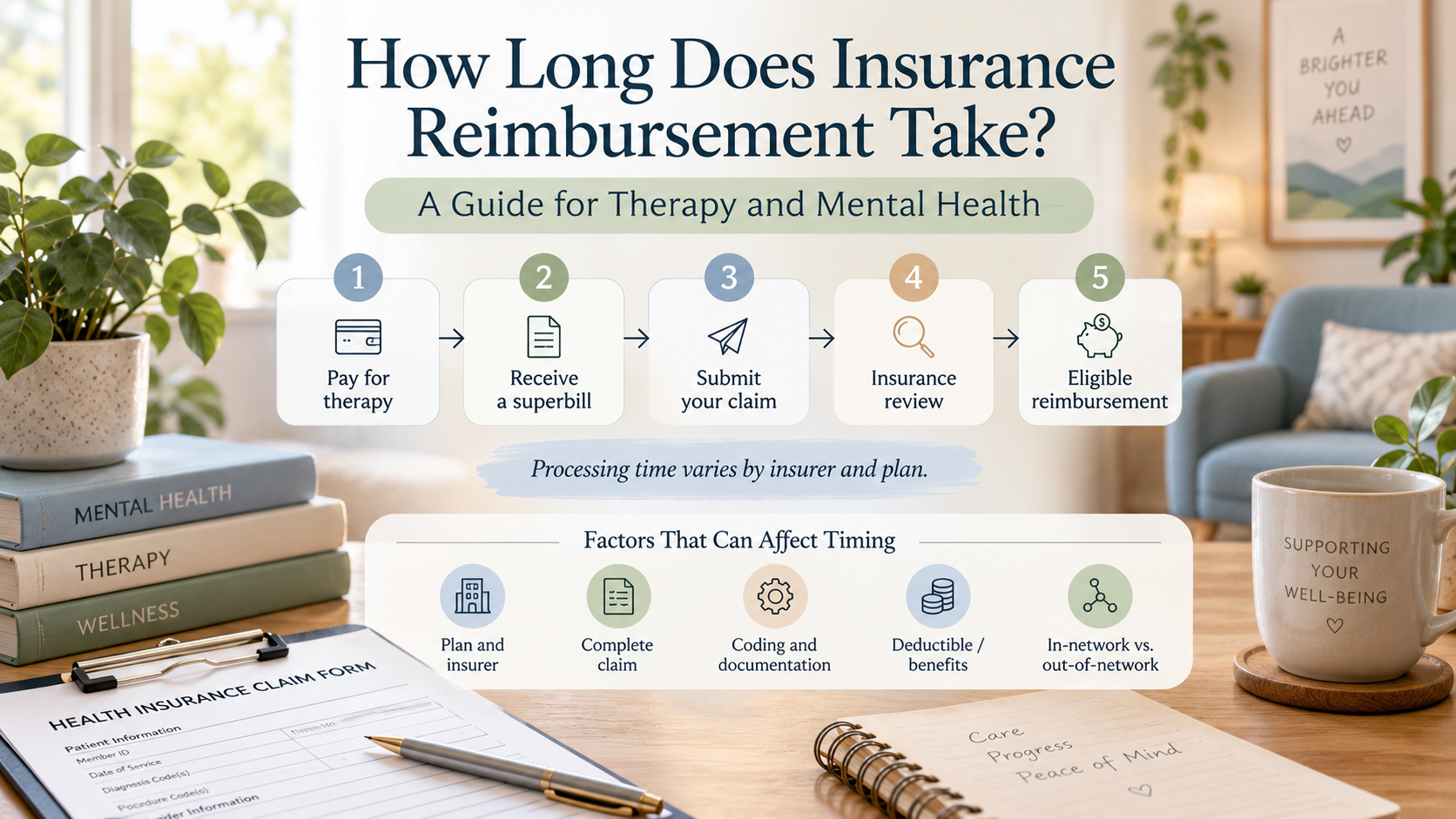
How Long Does Insurance Reimbursement Take? A Guide for Therapy and Mental Health
If you pay for therapy out of pocket and submit a claim or superbill to your health insurance plan, you may wonder: how long does insurance reimbursement take?
The answer depends on your insurance plan, how the claim is submitted, whether the claim is complete, and whether the insurer needs additional information. Some claims are processed relatively quickly, while others can take longer if there are eligibility, coding, documentation, deductible, or coordination-of-benefits issues.
For therapy and other mental health services, reimbursement also depends on whether your therapist is in network or out of network and what your specific plan covers.
Quick answer: Health insurance reimbursement timelines vary by insurer and plan. If you are seeking out-of-network reimbursement for therapy, the process generally involves paying the provider, receiving documentation such as a superbill, submitting the claim to your insurer, waiting for the insurer to process it, and then receiving any eligible reimbursement according to your benefits.
How Long Does Health Insurance Reimbursement Take?
There is no single reimbursement timeline that applies to every health insurance plan.
The time from paying for a healthcare service to receiving reimbursement can involve several separate steps:
- You receive healthcare or therapy services.
- You pay the provider, when required.
- The provider gives you documentation, such as a receipt or superbill.
- You submit an out-of-network claim to your insurance company, if required.
- The insurer reviews the claim.
- The insurer determines the allowed amount and your plan’s responsibility.
- The insurer issues payment or an explanation of benefits (EOB).
- You receive reimbursement if your plan provides benefits for the service.
The important distinction is that claim processing time and reimbursement delivery time are not necessarily the same thing.
An insurer may process a claim before the reimbursement payment actually reaches you.
How Long Does It Take to Get Reimbursed From Health Insurance?
For a specific claim, the best way to determine the expected timeline is to check your insurance plan’s claims and reimbursement rules.
Your insurer may provide information about:
- How to submit an out-of-network claim
- Where to send the claim
- Whether electronic submission is available
- Required documentation
- Claim-processing timelines
- How reimbursements are issued
- How to check claim status
- What to do if a claim is denied
You can usually find this information in your member portal, plan documents, or by contacting the member-services number on your insurance card.
Because requirements differ among plans, don’t assume that a reimbursement will arrive within a specific number of days simply because another insurer uses that timeline.
How Long Does Insurance Reimbursement Take for Therapy?
Therapy reimbursement can follow the same general process as other out-of-network healthcare claims, but mental health benefits have additional plan-specific considerations.
For example, your plan may have different:
- Deductibles
- Copayments
- Coinsurance
- In-network benefits
- Out-of-network benefits
- Mental health coverage
- Visit limitations or authorization requirements
If your therapist is out of network, you may need to pay the therapist directly and submit a claim to your insurance company.
A superbill can provide the information needed to support an out-of-network reimbursement request, although the exact documentation required depends on the insurer.
Learn more in our guide to a ++superbill for therapists++.
What Is a Superbill and How Does It Affect Reimbursement?
A superbill is a healthcare billing document that summarizes services provided to a patient.
A therapy superbill may include information such as:
- Therapist or provider information
- Provider NPI
- Patient information
- Date of service
- Service or procedure information
- Diagnosis information, when applicable
- Amount charged
- Amount paid
- Other information required by the payer
Patients can use the document when submitting an eligible out-of-network claim.
However, a superbill does not guarantee reimbursement.
Whether an insurer reimburses the patient depends on the patient’s specific plan and the claim’s eligibility.
For more information, see our ++mental health superbill template++.
What Can Delay Insurance Reimbursement?
Several issues can slow down a reimbursement claim.
1. Missing information
A claim may take longer to process if required information is missing or incorrect.
Examples can include:
- Incorrect patient information
- Incorrect member or policy information
- Missing provider information
- Missing claim information
- Incorrect service information
- Missing documentation
Before submitting a claim, review the information carefully.
2. Incorrect or inconsistent coding
Healthcare claims rely on standardized coding and billing information.
Errors or inconsistencies involving procedure or diagnosis information can result in additional review, a request for correction, or a denial.
Providers should use current authoritative coding guidance and verify payer-specific requirements rather than relying on an old template or example.
For coding resources, see:
- ++CMS ICD-10++
- ++CDC ICD-10-CM++
- ++American Medical Association CPT++
3. The claim requires additional information
An insurer may request additional information before determining whether a claim is payable.
When that happens, the reimbursement process can take longer than a straightforward claim.
4. Eligibility problems
A claim can encounter problems if the patient’s coverage was not active for the date of service or if other eligibility information does not match.
5. Deductible considerations
A patient may assume that insurance will reimburse a percentage of a therapy session but discover that the deductible has not yet been met.
In that situation, the insurer may apply the allowed amount toward the deductible rather than issue the expected reimbursement.
6. Out-of-network processing
Out-of-network claims can involve different benefits and reimbursement rules from in-network claims.
Patients should verify their out-of-network mental health benefits before assuming that a therapy service will be reimbursed.
7. Coordination of benefits
If a patient has more than one health insurance plan, the insurers may need to determine which plan is primary.
That additional process can delay payment.
Does Insurance Reimburse You or Your Therapist?
It depends on how the service is billed and the patient’s insurance arrangement.
For an out-of-network therapy claim, a common arrangement is:
Patient pays therapist → patient receives superbill → patient submits claim → insurer processes claim → insurer reimburses eligible amount
For an in-network service, the therapist typically submits the claim directly to the insurance company and the patient pays the applicable copay, coinsurance, or deductible amount.
The exact process depends on the provider, insurer, and plan.
How Much Will Insurance Reimburse for Therapy?
The amount you receive is separate from how long reimbursement takes.
Insurance reimbursement can depend on:
- Your plan’s deductible
- Copay
- Coinsurance
- Out-of-network benefits
- The insurer’s allowed amount
- Whether the service is covered
- Whether prior authorization applies
- The provider’s network status
- The specific service provided
For example, suppose a therapist charges $180 for a session.
That does not necessarily mean the insurer will calculate reimbursement from the full $180.
The insurer may determine an allowed amount based on the plan’s rules. Your deductible, coinsurance, and out-of-network benefits may then affect how much the insurer pays and how much you ultimately receive.
This is why it is important to distinguish between:
Provider’s fee → Allowed amount → Insurance responsibility → Patient responsibility
Read more about this in ++How Much Does Insurance Pay for Therapy?++.
How Do I Check the Status of an Insurance Reimbursement?
If you have submitted a claim and have not received reimbursement, start by checking your insurer’s member portal.
Look for information such as:
- Claim received date
- Claim status
- Processing status
- Allowed amount
- Amount applied to deductible
- Insurance payment
- Patient responsibility
- Denial or adjustment reason
- Request for additional information
If the claim does not appear in your account, contact your insurer and ask whether the claim was received.
Have the following information available:
- Member ID
- Date of service
- Provider name
- Provider NPI, when applicable
- Claim number, if available
- Amount charged
- Date the claim was submitted
What Does an Explanation of Benefits (EOB) Tell You?
An Explanation of Benefits, or EOB, helps explain how your insurance company handled a claim.
An EOB may show:
| Item | What it means |
| Provider charge | Amount the provider billed or charged |
| Allowed amount | Amount the insurer recognizes under the plan’s rules |
| Deductible | Amount applied toward your deductible |
| Copay | Fixed amount you may owe |
| Coinsurance | Percentage you may owe |
| Insurance paid | Amount paid by the insurer |
| Patient responsibility | Amount assigned to you |
An EOB is generally not a bill. It is an explanation of how the insurance company processed the claim.
If the EOB does not match what you expected, review the claim details and contact your insurer for clarification.
What If My Insurance Reimbursement Is Taking Too Long?
If you have been waiting longer than the timeline provided by your insurer, take these steps:
Step 1: Confirm the claim was submitted
Check your insurer’s portal or contact member services.
Step 2: Check for missing information
Look for requests from the insurer asking for documentation or corrections.
Step 3: Review the claim status
Determine whether the claim is:
- Pending
- Processing
- Approved
- Denied
- Adjusted
- Awaiting additional information
Step 4: Review your EOB
If an EOB has already been issued, determine whether the claim was processed differently from what you expected.
Step 5: Contact the insurer
Ask specifically:
“Can you tell me the current status of my claim and whether anything is needed from me before it can be processed?”
Step 6: Follow up if necessary
Keep records of:
- Submission dates
- Claim numbers
- Phone calls
- Representative names
- Documents submitted
- EOBs
- Correspondence
This makes it easier to resolve a delayed or denied claim.
How Can Therapists Help Patients Get Reimbursed Faster?
Therapists cannot control an insurance company’s processing time, but they can make the administrative side of the process more reliable.
Accurate documentation can help reduce avoidable problems.
A therapist’s workflow should make it easy to:
- Record patient information accurately.
- Document services consistently.
- Maintain appropriate billing information.
- Generate superbills accurately.
- Provide patients with documentation promptly.
- Correct administrative errors quickly.
- Track outstanding billing tasks.
The goal isn’t to promise faster insurance decisions. The goal is to reduce preventable administrative friction before a claim reaches the insurer.
How Software Can Simplify Therapy Insurance Administration
For therapists managing out-of-network patients, creating superbills manually can become repetitive.
A billing or practice-management workflow can help organize:
- Patient information
- Provider information
- Dates of service
- Billing records
- Payment information
- Superbill generation
- Administrative follow-up
This becomes increasingly important as a practice grows.
Instead of rebuilding documents manually for every patient and every visit, therapists can use structured workflows to reduce repetitive administrative work.
++DeputyCare++ is designed around the administrative side of healthcare, including billing, insurance, superbills, and automation.
Can AI Speed Up Insurance Reimbursement?
AI can help automate parts of the administrative workflow, but it cannot control how quickly an insurance company processes or pays a claim.
For example, AI-assisted workflows may help with:
- Organizing billing information
- Identifying missing administrative data
- Drafting or organizing documentation
- Reducing repetitive data entry
- Supporting workflow automation
- Helping staff identify tasks that need attention
Human review remains important, particularly for sensitive healthcare information and billing decisions.
Any AI system used with protected health information should be implemented with appropriate privacy, security, access controls, and contractual safeguards where applicable. See the ++U.S. Department of Health & Human Services HIPAA resources++ for authoritative guidance.
Learn more about the role of AI in this workflow in ++How AI Is Transforming Therapy Superbill and Insurance Workflows++.
How Long Does Insurance Reimbursement Take? A Simple Example
Imagine a patient has an out-of-network therapy appointment.
The process might look like this:
Monday:
The patient attends therapy and pays the therapist.
Tuesday:
The therapist provides the patient with the appropriate billing documentation or superbill.
Wednesday:
The patient submits the claim to their insurance company.
After submission:
The insurer receives and reviews the claim.
Next:
The insurer determines how the claim is handled under the patient’s benefits.
After processing:
The patient receives an EOB and, when applicable, reimbursement according to the plan.
The important point is that there is no universal number of days that applies to every claim.
The timeline can change depending on the insurer, plan, submission method, completeness of the claim, and whether additional review is required.
How Can Patients Avoid Delays?
Before submitting an out-of-network therapy claim, use this checklist:
Insurance reimbursement checklist
- Confirm that your plan covers out-of-network mental health services.
- Check whether your deductible applies.
- Confirm your coinsurance or reimbursement terms.
- Ask whether prior authorization is required.
- Confirm how the insurer wants claims submitted.
- Make sure patient information is correct.
- Make sure provider information is correct.
- Review the date of service.
- Check the service and diagnosis information.
- Keep a copy of the submitted claim.
- Keep your superbill or other supporting documentation.
- Track the claim number.
- Save the EOB when the claim is processed.
Frequently Asked Questions
How long does insurance reimbursement take?
There is no universal timeline. It depends on the insurance company, plan, claim type, submission method, completeness of the claim, and whether additional information is required.
How long does health insurance reimbursement take?
Health insurance reimbursement can vary substantially by insurer and plan. Check your plan documents or contact your insurer for its specific claim-processing and reimbursement procedures.
How long does it take to get reimbursed from insurance for therapy?
For out-of-network therapy, reimbursement generally requires the patient to submit a claim and wait for the insurer to process it. The exact timeline depends on the patient’s insurance plan and whether the claim requires additional review.
Does a superbill guarantee insurance reimbursement?
No. A superbill documents healthcare services, but it does not guarantee that an insurance company will reimburse the patient. Coverage and reimbursement depend on the patient’s specific plan and claim.
Why is my insurance reimbursement taking so long?
Possible reasons include missing information, incorrect claim details, eligibility issues, additional documentation requests, coordination of benefits, or additional claim review.
How do I find out when my insurance will reimburse me?
Check your insurer’s member portal or contact the member-services number on your insurance card. Ask whether the claim has been received, whether it is still processing, and whether anything is needed from you.
Does insurance reimburse the therapist or the patient?
It depends on the billing arrangement. In many out-of-network situations, the patient pays the therapist and submits a claim for potential reimbursement. In-network providers generally submit claims directly to the insurer.
Can therapists control how quickly insurance pays?
No. Insurance companies control their own claim-processing and payment procedures. Therapists can, however, reduce avoidable administrative delays by maintaining accurate billing information and providing patients with documentation promptly.
Final Takeaway
How long does insurance reimbursement take? There isn’t one answer for every patient or every claim.
For therapy, the process can be especially important when a patient sees an out-of-network provider. The typical workflow is:
Therapy session → payment → superbill/documentation → insurance claim → claim processing → EOB → eligible reimbursement
The best way to get an accurate timeline is to check the patient’s specific insurance plan and ask the insurer about the claim-processing process.
For therapists, the opportunity is different: while you cannot control the insurer’s processing time, you can make the administrative workflow more accurate, consistent, and efficient.
That is where organized billing, superbill generation, insurance workflows, and automation can make a meaningful difference.
Related DeputyCare Resources
- ++Superbill for Therapists++
- ++How to Create a Superbill for Therapy++
- ++Mental Health Superbill Template++
- ++How Much Does Insurance Pay for Therapy?++
- ++Why Don’t Therapists Take Insurance?++
- ++How AI Is Transforming Therapy Superbill and Insurance Workflows++
Authoritative Resources
- ++HealthCare.gov++
- ++U.S. Department of Labor — Mental Health Parity++
- ++CMS — ICD-10 Codes++
- ++CDC — ICD-10-CM++
- ++HHS — HIPAA for Professionals++
SEO + AEO Publishing Package
Primary keyword:
how long does insurance reimbursement take
Primary search intent: Informational / healthcare insurance reimbursement
High-value supporting keywords:
| Keyword | Monthly searches |
| how long does health insurance reimbursement take | 55 |
| how long does it take to get reimbursed from an insurance company | 50 |
| how long does insurance reimbursement take physical therapy | 40 |
| how long does it take to be reimbursed from health insurance | 40 |
| how long does it take to get reimbursed from insurance | 40 |
| how long does it take to get reimbursed from insurance mental health | 12 |
| how long does it take for insurance to reimburse | 12 |
Recommended SEO title:
How Long Does Insurance Reimbursement Take? Therapy Guide
Recommended meta description:
How long does insurance reimbursement take? Learn how therapy claims, superbills, out-of-network benefits, EOBs, and insurance reimbursement timelines work.
Recommended URL slug:
/blog/how-long-does-insurance-reimbursement-take
Recommended H1:
How Long Does Insurance Reimbursement Take? A Guide for Therapy and Mental Health
Featured Snippet / AI Search Targets
The article intentionally answers these questions directly:
- How long does insurance reimbursement take?
- How long does health insurance reimbursement take?
- How long does insurance reimbursement take for therapy?
- How long does it take to get reimbursed from insurance?
- Why is my insurance reimbursement taking so long?
- How do I check the status of an insurance reimbursement?
- Does insurance reimburse the therapist or patient?
- Does a superbill guarantee reimbursement?
Recommended Structured Data
Have the development/SEO team consider:
- Article
- FAQPage only where eligible under current Google guidelines
- BreadcrumbList
Do not treat schema as a guarantee of a rich result.
Content Optimization Notes
For maximum AI-search visibility, keep the Quick Answer near the top, retain the reimbursement workflow as a simple sequence, and keep the FAQ answers self-contained. The article also creates a strong internal-link path between insurance → therapy reimbursement → superbill → billing software → AI automation, rather than treating this as an isolated blog post.