Mental Health Superbill Template: What to Include + Free Example
A mental health superbill is an itemized document that summarizes the healthcare services a patient received from a mental health provider. Patients may use a superbill when requesting reimbursement from their health insurance company for eligible out-of-network therapy or behavioral health services.
If you’re looking for a mental health superbill template, this guide provides a practical example you can use as a starting point.
We’ll explain:
- What a mental health superbill is
- What information a superbill should include
- How CPT and diagnosis information fit into the document
- What a therapy superbill example looks like
- How patients use a superbill for out-of-network reimbursement
- Common superbill mistakes to avoid
- How software can simplify superbill creation
Quick answer: A mental health superbill typically includes provider information, patient information, dates of service, applicable procedure/CPT codes, diagnosis information when required, charges, payments, and other information required by the payer. Requirements can vary, so patients should confirm claim requirements with their insurance company.
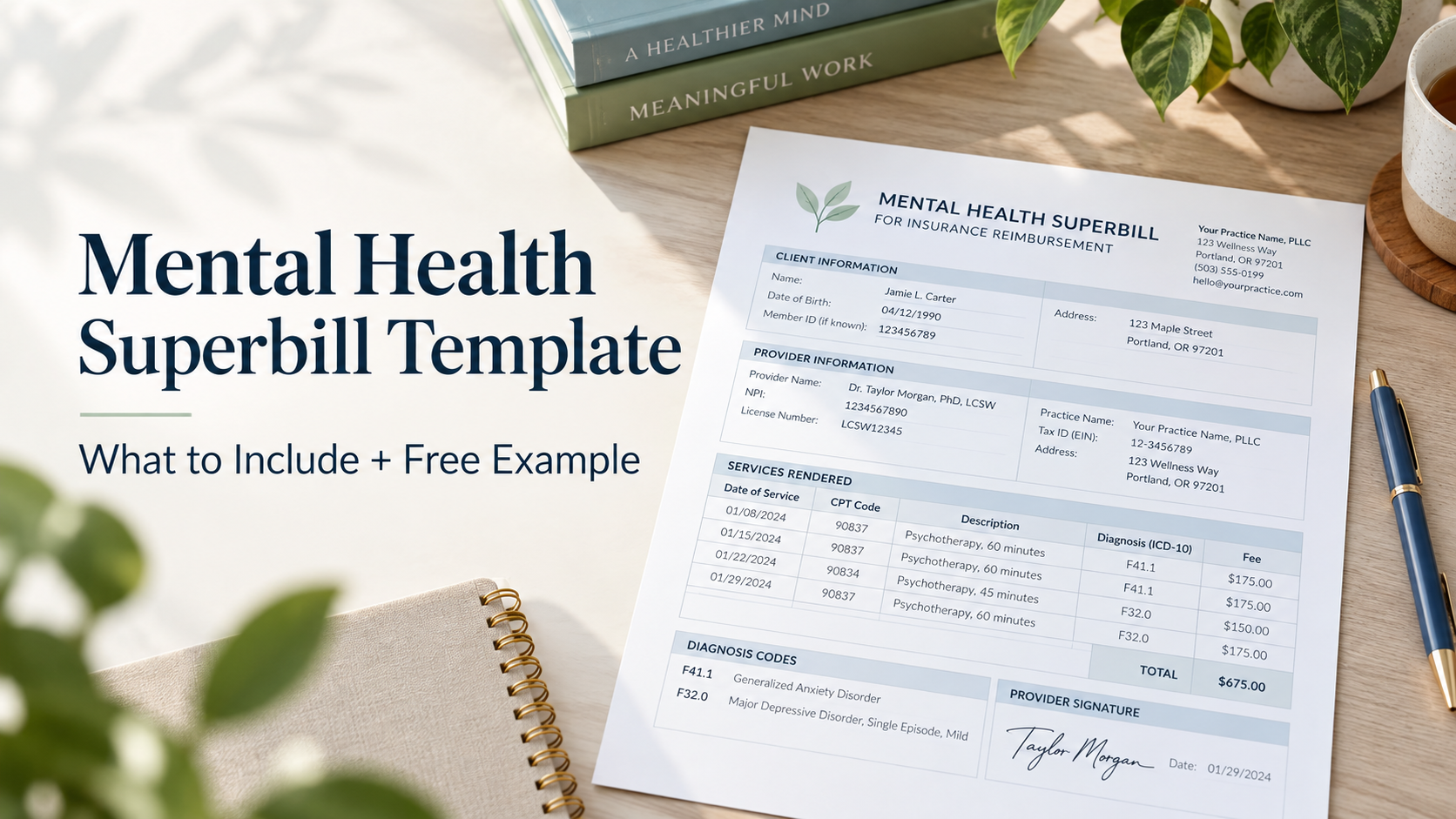
Free Mental Health Superbill Template
Here is a simple mental health superbill format you can adapt for a therapy practice.
MENTAL HEALTH SUPERBILL
Provider Information
Provider Name: Jane Smith, LCSW
Practice Name: Smith Therapy Services
Address: 123 Main Street, Suite 200
City, State ZIP: Austin, TX 78701
Phone: (555) 555-0123
NPI: 1234567890
Patient Information
Patient Name: Alex Johnson
Date of Birth: 05/12/1990
Address: 456 Oak Street
City, State ZIP: Austin, TX 78702
Services
| Date of Service | Service | Procedure/CPT Code | Diagnosis | Charge | Paid |
| 01/08/2026 | Psychotherapy | [Applicable code] | [Applicable diagnosis] | $150 | $150 |
| 01/15/2026 | Psychotherapy | [Applicable code] | [Applicable diagnosis] | $150 | $150 |
| 01/22/2026 | Psychotherapy | [Applicable code] | [Applicable diagnosis] | $150 | $150 |
| Total | $450 | $450 |
Total Charges: $450
Total Paid: $450
Balance Due: $0
Provider Signature: ______________________________
Date: __________________
Important: This is an educational example, not a universal insurance form. The information, codes, fields, signatures, and supporting documentation required can vary by provider, service, insurer, and health plan. Verify current requirements before submitting a claim.
What Is a Mental Health Superbill?
A mental health superbill is an itemized statement of services provided by a mental health professional.
It can contain information an insurance company may need when evaluating a patient’s request for reimbursement for eligible out-of-network care.
A superbill may be used by:
- Therapists
- Psychologists
- Psychiatrists
- Licensed clinical social workers
- Marriage and family therapists
- Professional counselors
- Other behavioral health providers
A superbill is generally not an insurance claim itself.
Instead, it can provide information that a patient uses when submitting an out-of-network claim to their insurance company.
The insurer then evaluates the claim according to the patient’s specific plan and applicable requirements.
What Should a Mental Health Superbill Include?
A mental health superbill should contain enough accurate information to identify:
- Who provided the service
- Who received the service
- When the service occurred
- What service was provided
- Why the service was provided, when applicable
- What was charged
- What was paid
Common sections include:
- Provider information
- Patient information
- Date of service
- Service description
- CPT/procedure code
- Diagnosis code
- Amount charged
- Amount paid
- Provider identifiers
- Signature or authorization, when required
Not every payer requires exactly the same fields.
1. Provider Information
The first section should identify the healthcare provider who delivered the service.
Depending on the situation, this may include:
- Provider’s full name
- Professional credentials
- Practice name
- Practice address
- Phone number
- National Provider Identifier (NPI)
- Tax identification information, when required
What is an NPI?
An NPI, or National Provider Identifier, is a unique identifier used for covered healthcare providers in the United States.
The Centers for Medicare & Medicaid Services (CMS) provides information about the ++National Provider Identifier Standard++.
For a superbill, use the provider information applicable to the provider and the claim.
2. Patient Information
The superbill should identify the person who received the service.
Depending on the payer and claim requirements, this may include:
- Patient name
- Date of birth
- Address
- Insurance information
- Member ID
- Subscriber information, when applicable
Patient information should be entered accurately and consistently.
If information does not match the patient’s insurance records, the patient may need to correct the claim or provide additional information.
3. Date of Service
Every service listed on the superbill should have a corresponding date of service.
For patients attending therapy regularly, a single superbill may contain multiple appointments.
For example:
| Date of Service | Service |
| January 8, 2026 | Individual psychotherapy |
| January 15, 2026 | Individual psychotherapy |
| January 22, 2026 | Individual psychotherapy |
Keeping each service tied to its date makes the document easier for the patient and payer to understand.
4. Therapy Service and CPT Code
A mental health superbill generally identifies the service using an applicable CPT or procedure code.
The correct code depends on the service actually provided and the circumstances of the encounter.
For example, psychotherapy services can have different procedure codes depending on factors such as the type and duration of the service.
The provider should use the appropriate current code for the service actually delivered rather than copying a code from another provider’s superbill.
The American Medical Association maintains information about ++CPT coding++.
Coding note: CPT codes and coding requirements can change. This article should not be used as a substitute for current coding guidance or professional billing advice.
5. Diagnosis Information
A superbill may include a diagnosis code associated with the service.
Diagnosis information can be sensitive because it may communicate information about a patient’s mental health condition to an insurer.
Providers should use accurate diagnosis information consistent with their clinical documentation and applicable requirements.
The ICD-10-CM classification is maintained by the Centers for Disease Control and Prevention’s National Center for Health Statistics and is used in the United States for diagnosis coding.
See the ++CDC ICD-10-CM resources++ and ++CMS ICD-10 resources++.
Privacy consideration: Patients should understand that submitting a mental health insurance claim can involve sharing diagnosis and other healthcare information with an insurer.
6. Amount Charged
The superbill should clearly show the amount charged for each service.
For example:
| Date | Service | Amount Charged |
| Jan. 8 | Psychotherapy | $150 |
| Jan. 15 | Psychotherapy | $150 |
| Jan. 22 | Psychotherapy | $150 |
| Total | $450 |
The amounts should match the provider’s billing records.
7. Amount Paid
If the patient has paid for the service, the superbill should distinguish between:
- Amount charged
- Amount paid
- Remaining balance, if applicable
For example:
Amount charged: $150
Amount paid: $150
Balance: $0
This distinction can be useful when an insurer evaluates an out-of-network reimbursement request.
8. Provider Signature or Authorization
Some insurers or claim processes may require a provider signature or other authorization.
There is no single signature requirement that applies to every superbill.
Patients should check their insurer’s current requirements before submitting a claim.
Mental Health Superbill Example
Imagine that Alex sees an out-of-network therapist three times in January.
The therapist charges $150 per session, and Alex pays the full amount.
A simple superbill might show:
| Date | Service | Charge | Paid |
| 01/08/2026 | Psychotherapy | $150 | $150 |
| 01/15/2026 | Psychotherapy | $150 | $150 |
| 01/22/2026 | Psychotherapy | $150 | $150 |
| Total | $450 | $450 |
The document also identifies the provider and patient and contains the applicable service and diagnosis information.
Alex can then follow the insurance company’s process for submitting an out-of-network claim.
Whether Alex receives reimbursement depends on the terms of the insurance plan.
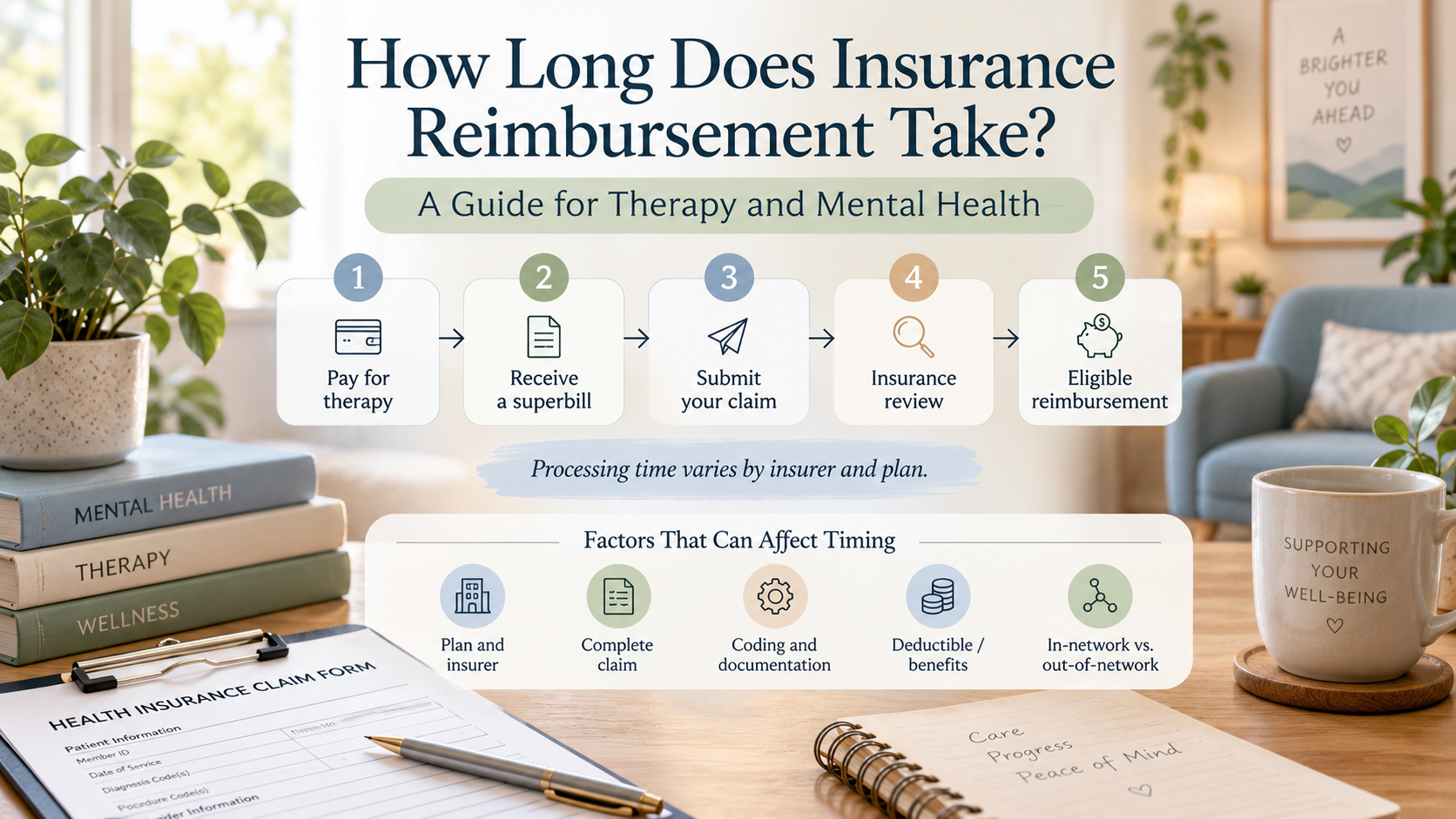
How Do You Use a Mental Health Superbill for Insurance?
A superbill is generally used as part of an out-of-network reimbursement workflow.
The process commonly looks like this:
Step 1: Check your insurance benefits
Before paying for out-of-network therapy, contact your insurance company and ask:
- Does my plan cover out-of-network mental health services?
- What is my out-of-network deductible?
- What percentage or amount may be reimbursed?
- Is there a reimbursement limit?
- Do I need prior authorization?
- Is there a specific claim form?
- How should I submit the claim?
Don’t assume that having an insurance policy means every therapy service is reimbursable.
Step 2: Pay your therapist
Your therapist’s payment policy determines when and how you pay for services.
Step 3: Receive the superbill
The therapist provides an itemized superbill containing the relevant service and billing information.
Step 4: Review the superbill
Check:
- Your name
- Date of birth
- Dates of service
- Provider information
- Service information
- Charges
- Payments
- Other required information
Step 5: Submit your claim
Follow your insurance company’s instructions.
Depending on the insurer, claims may be submitted through:
- An online member portal
- A mobile application
- Another insurer-approved process
Step 6: Wait for processing
The insurer evaluates the claim according to your plan’s benefits and requirements.
A superbill does not guarantee reimbursement.
Does a Superbill Guarantee Insurance Reimbursement?
No.
A superbill is documentation that can support an insurance reimbursement request. It does not guarantee that the claim will be approved or that the patient will receive a particular reimbursement amount.
Reimbursement can depend on factors such as:
- Whether the provider is in or out of network
- The patient’s plan
- Out-of-network benefits
- Deductible status
- Covered services
- Claim requirements
- Applicable reimbursement rules
- Whether the service is eligible under the plan
Patients should contact their insurance company for information about their specific benefits.
Superbill vs. Invoice: What’s the Difference?
A receipt primarily confirms that payment was made.
An invoice generally tells a customer what they owe or provides a record of charges.
A superbill is a more detailed healthcare document that can contain information used in an insurance reimbursement process.
Example
Invoice:
Therapy session — $150 due
Superbill:
Provider + patient + date of service + service/procedure information + diagnosis information + charge + payment information
A therapy practice may use invoices, receipts, and superbills as different parts of the same billing workflow.
Superbill vs. Insurance Claim
These documents serve different purposes.
Superbill
An itemized document containing information about healthcare services and payment.
Insurance claim
A request submitted to an insurer for payment or reimbursement.
For out-of-network therapy, a patient may use information from a superbill when submitting an insurance claim.
The superbill supports the process; it is not itself a guarantee of payment.
Free Mental Health Superbill Template: PDF, Word, or Excel?
Many therapists search for a free mental health superbill template, PDF template, Word document, or Excel spreadsheet.
The file format is less important than whether the template contains the information needed for the intended billing workflow.
A basic template can be created in:
- Word
- Excel
- Google Sheets
- Practice-management software
However, a static template creates a maintenance problem if provider, patient, appointment, or billing information has to be entered manually each time.
For practices creating many superbills, a structured billing workflow can be more efficient than repeatedly editing a blank document.
Mental Health Superbill Template for Different Providers
The basic structure of a superbill can be useful across different behavioral health specialties.
Therapist Superbill
May be used for eligible psychotherapy or counseling services.
Psychotherapy Superbill
Can document psychotherapy services, applicable procedure information, diagnosis information, charges, and payments.
Psychiatrist Superbill
May contain information associated with psychiatric services, which can differ from psychotherapy services.
LCSW Superbill
A licensed clinical social worker may provide a superbill for eligible services according to their practice and the patient’s insurance requirements.
MFT Superbill
Marriage and family therapists may also use superbills when working with patients who have applicable out-of-network benefits.
The appropriate information and coding depend on the actual service and provider.
Common Mental Health Superbill Mistakes
A template can make the process easier, but a template doesn’t automatically make a superbill correct.
Watch for these common problems.
Missing provider information
The document should clearly identify the provider and include applicable identifiers.
Incorrect patient information
Patient information should be accurate and consistent with the relevant insurance records.
Missing dates of service
Every listed service should have a corresponding date.
Incorrect procedure information
The service information should accurately reflect what was provided.
Incorrect diagnosis information
Diagnosis information should be based on appropriate clinical documentation rather than guessed simply to complete a form.
Confusing charges and payments
Clearly distinguish what was charged from what the patient actually paid.
Assuming one template works for every insurer
Insurance companies and plans may have different claim requirements.
A superbill that appears complete may still require additional information for a particular claim.
Should Therapists Give Patients a Superbill?
For therapists who work with out-of-network patients, providing a properly prepared superbill can be an important part of the administrative workflow.
For patients, receiving a clear itemized document can make it easier to understand what information is being submitted for reimbursement.
For therapists, however, creating superbills can become repetitive.
Consider a practice with dozens of out-of-network appointments each week.
The practice may need to repeatedly:
- Record appointments
- Track payments
- Prepare billing information
- Generate superbills
- Check information
- Correct errors
- Send documents
- Answer patient questions
- Maintain records
This is why superbills are best thought of as part of a billing workflow, rather than isolated PDF documents.
How Software Can Simplify Mental Health Superbill Workflows
Creating one superbill manually isn’t particularly difficult.
Creating accurate superbills repeatedly is a different problem.
Practice-management and billing software can help organize information such as:
- Patient records
- Provider information
- Appointment dates
- Services
- Charges
- Payments
- Billing records
- Superbill information
A connected workflow can reduce repetitive data entry and make it easier to keep billing information consistent.
Instead of:
Appointment → Manual re-entry → Spreadsheet → Document → Email
a more structured workflow can connect:
Appointment → Service → Payment → Billing record → Superbill → Patient
The exact capabilities depend on the software being used.
How AI Can Improve Superbill Workflows
AI can add another layer of automation to administrative workflows.
For example, AI-powered software may be able to help identify:
- Missing information
- Inconsistent records
- Repeated data
- Documents requiring review
- Administrative tasks that need follow-up
The important principle is human review.
A sensible workflow is:
Capture → Organize → Check → Review → Finalize
AI can assist with repetitive administrative work, but providers should verify important billing and patient information before documents are finalized.
For a deeper look at this topic, see ++How AI Is Transforming Therapy Superbill and Insurance Workflows++.
How DeputyCare Can Help
Superbills are only one part of a larger therapy administration workflow.
DeputyCare is focused on helping healthcare and therapy practices streamline administrative processes around billing, insurance, superbills, and automation.
Instead of managing appointments, payments, billing information, and superbills as disconnected tasks, practices can work toward a more connected administrative workflow.
Appointments → Services → Payments → Billing → Superbills → Insurance
For practices handling recurring out-of-network billing, reducing repetitive administrative work can make the overall process easier to manage.
Mental Health Superbill FAQ
What is a mental health superbill?
A mental health superbill is an itemized statement documenting services provided by a mental health professional. Patients may use it when requesting reimbursement from an insurance company for eligible out-of-network services.
What information should be on a mental health superbill?
A mental health superbill may include provider information, patient information, dates of service, service or CPT information, diagnosis information, charges, payments, provider identifiers, and other information required by the payer.
Can I create my own mental health superbill?
Patients generally receive a superbill from their healthcare provider because the provider supplies information about the services actually delivered.
Therapists can create superbills using a template or billing software.
Is there a free mental health superbill template?
Yes, a basic template can be created using a document or spreadsheet. The template above provides a starting structure.
However, practices should verify that their template contains the information required for their particular workflow and patients should confirm claim requirements with their insurer.
Can I download a mental health superbill template as a PDF?
A superbill can be created and delivered as a PDF, provided the information contained in it is accurate and appropriate for the intended billing workflow.
The file format itself does not determine whether an insurer will accept a claim.
Can I use an Excel mental health superbill template?
Yes. An Excel or spreadsheet-based template can be useful for organizing multiple service dates and calculating totals.
For a practice generating many superbills, however, manually maintaining spreadsheets may become cumbersome compared with an integrated billing workflow.
What CPT code should I put on a therapy superbill?
The appropriate procedure/CPT code depends on the service actually provided and the applicable coding requirements.
Providers should use current, appropriate coding guidance rather than copying a code from another template.
Does a mental health superbill need an ICD-10 code?
Diagnosis information may be included on a mental health superbill when required for the applicable billing or reimbursement process.
Requirements can vary, so providers and patients should verify the relevant payer requirements.
Does a superbill guarantee insurance reimbursement?
No.
A superbill supports an insurance reimbursement request but does not guarantee payment. Reimbursement depends on the patient’s insurance plan, eligibility, benefits, claim requirements, and other applicable factors.
Can I use a superbill for out-of-network therapy?
Potentially.
If a health plan provides out-of-network mental health benefits, a patient may be able to submit eligible therapy expenses for reimbursement.
Patients should verify their benefits directly with their insurer.
Do all insurance companies accept the same superbill?
Not necessarily.
Insurance companies and individual plans may have different requirements for out-of-network claims.
Patients should verify the insurer’s current requirements before submitting a claim.
How often should a therapist provide a superbill?
There is no single schedule that applies to every practice.
Some therapists provide superbills after individual appointments, while others provide documents covering multiple appointments.
The practice’s workflow and the patient’s needs can determine the appropriate approach.
Can software generate mental health superbills?
Some billing and practice-management platforms can help automate or simplify superbill generation.
The important consideration is whether the resulting information is accurate and appropriate for the intended claim.
Mental Health Superbill Checklist
Before giving a superbill to a patient, review the following:
Provider
- Provider name
- Credentials
- Practice name
- Address
- Contact information
- NPI, when applicable
- Other required provider information
Patient
- Full name
- Date of birth
- Address, when required
- Insurance/member information, when applicable
Services
- Date of service
- Service description
- Appropriate procedure/CPT information
- Diagnosis information, when applicable
- Amount charged
- Amount paid
- Remaining balance, if applicable
Final review
- Information is accurate
- Charges match billing records
- Payments match payment records
- Required signatures/authorization are included
- Patient has been advised to verify insurer requirements
Final Thoughts
A mental health superbill is more than a receipt. It can provide important information used in the out-of-network therapy reimbursement process.
For patients, understanding what a superbill contains can make insurance reimbursement easier to navigate.
For therapists, creating superbills is one of many administrative responsibilities that can become increasingly time-consuming as a practice grows.
The best starting point is a consistent template containing accurate provider, patient, service, diagnosis, charge, and payment information.
But the bigger opportunity is building a workflow that captures that information correctly from the beginning.
When appointments, services, payments, billing, and superbills are connected, practices can reduce repetitive administrative work and spend less time recreating information.
For therapists looking to modernize their administrative workflows, automation and AI can help—but important healthcare and billing information should always receive appropriate human review.
Related Reading
- ++Superbill for Therapists: Complete Guide++
- ++How to Create a Superbill for Therapy++
- ++How AI Is Transforming Therapy Superbill and Insurance Workflows++
- ++Why Don’t Therapists Take Insurance?++
- How to Submit a Superbill to Insurance
- Out-of-Network Reimbursement for Therapy
- Superbill vs. Insurance Claim
Authoritative Resources
- ++CMS — National Provider Identifier Standard++
- ++CMS — ICD-10 Codes++
- ++CDC — ICD-10-CM++
- ++American Medical Association — CPT++
- ++HHS — HIPAA for Professionals++
This article is for educational purposes only and does not constitute medical, legal, insurance, coding, billing, or compliance advice. Insurance requirements and reimbursement policies vary by insurer and plan. Providers should use current professional coding and billing guidance, and patients should contact their insurance company regarding their specific benefits and claim requirements.