Is My Therapist In or Out of Network? How to Check and What It Means
To find out whether your therapist is in or out of network, check your insurance company’s provider directory, ask your therapist, and confirm directly with your insurance plan.
A therapist being “in network” or “out of network” can significantly affect what you pay for therapy.
An in-network therapist generally has a contractual relationship with your insurance plan. An out-of-network therapist generally does not have that same contractual relationship.
But out of network does not always mean your insurance won’t pay anything.
Some health insurance plans provide out-of-network benefits. If yours does, you may be able to see an out-of-network therapist, pay the therapist directly, submit a claim, and receive reimbursement for eligible services according to your plan.
The important question isn’t just:
“Does my therapist take insurance?”
It’s:
“Is my therapist in network with my specific insurance plan, and what benefits apply if they’re out of network?”
This guide explains how to check your therapist’s network status, what in-network and out-of-network mean, how much the difference can matter, and what to do if your therapist is out of network.
What Does “In Network” Mean for a Therapist?
An in-network therapist generally has an agreement with an insurance company or health plan to participate in that plan’s provider network.
That agreement can affect:
- How the provider bills the insurer
- The rates used to process covered services
- What the patient owes
- How claims are handled
If your therapist is in network, you may have a copay, coinsurance, or deductible depending on your plan.
Being in network does not necessarily mean therapy is free.
You may still owe part of the cost.
What Does “Out of Network” Mean for a Therapist?
An out-of-network therapist generally does not have a contracted relationship with your particular insurance plan.
That can mean:
- You pay the therapist directly.
- The therapist may not bill your insurer directly.
- Your plan may apply different cost-sharing.
- You may have a separate out-of-network deductible.
- Your plan may provide partial reimbursement.
- You may need to submit the claim yourself.
But every insurance plan is different.
Some plans provide no out-of-network benefits.
Others may provide substantial benefits for eligible out-of-network services.
That’s why “out of network” does not automatically mean “not covered.”
How Do I Check If My Therapist Is In Network?
Use more than one source whenever possible.
1. Ask Your Therapist
Start by asking the therapist directly:
“Are you in network with my specific insurance plan?”
Give them the exact name of your insurance plan.
Don’t simply ask:
“Do you take [insurance company]?”
An insurer may offer multiple plans and networks.
A therapist may participate in one network but not another.
2. Check Your Insurance Company’s Provider Directory
Most insurers provide an online provider directory.
Search for:
- Therapist name
- Practice name
- Location
- Specialty
- Insurance plan
If your therapist appears in the directory, that can be a useful indication of network participation.
However, provider directories can change and may contain outdated information.
That’s why it’s wise to confirm directly with the insurer.
3. Call Your Insurance Company
This is one of the most reliable ways to verify your benefits before beginning treatment.
Ask:
“Is [therapist’s name] an in-network provider for my specific plan?”
Then ask:
“Are outpatient mental health therapy services covered with this provider?”
And:
“What would my expected cost be for an appointment?”
If the therapist is out of network, ask:
“Does my plan have out-of-network mental health benefits?”
Why You Should Verify Network Status Yourself
A therapist’s website, directory listing, or insurance page isn’t always enough to determine your actual benefits.
Network participation can depend on:
- Insurance company
- Specific plan
- Network
- Provider
- Location
- Effective dates
- Type of service
Your insurance company ultimately determines how a claim is processed under your plan.
That’s why it’s smart to confirm both network status and benefits before starting regular therapy.
What Should I Ask My Insurance Company?
Use this checklist when you call.
Network status
- Is my therapist in network for my specific plan?
- Is the therapist listed under the correct provider name?
- Is the therapist’s location covered under my plan?
Therapy benefits
- Does my plan cover outpatient mental health therapy?
- What is my in-network copay?
- What is my in-network deductible?
- What is my coinsurance?
Out-of-network benefits
If the therapist is out of network:
- Does my plan provide out-of-network mental health benefits?
- What is my out-of-network deductible?
- How much of it have I met?
- What percentage does the plan reimburse after the deductible?
- How is the allowed amount determined?
- Do I need to submit the claim myself?
Claim requirements
- Do I need a claim form?
- Do I need a superbill?
- Where do I submit the claim?
- Is there a filing deadline?
- How can I track the claim?
Write down the answers and the date you spoke with the insurer.
In-Network vs. Out-of-Network Therapist
Here’s the basic difference:
| In-network therapist | Out-of-network therapist | |
| Insurance contract | Generally has one with the plan | Generally does not |
| Insurance may cover therapy | Yes, subject to plan terms | May, if out-of-network benefits apply |
| Patient payment | Often copay/coinsurance/deductible | Often therapist’s fee upfront |
| Claim submission | Provider may handle billing | Patient may need to submit a claim |
| Reimbursement | Often handled between provider and insurer | May be paid to patient depending on the plan and claim |
| Cost | Often more predictable | Can require more calculation |
| Provider choice | Limited to participating network | Potentially broader |
These are general patterns, not guarantees.
Your insurance plan determines the actual rules.
Is an Out-of-Network Therapist Covered by Insurance?
Sometimes.
The answer depends primarily on whether your plan provides out-of-network benefits.
If it does, you may be able to receive reimbursement for eligible therapy services.
For example:
- Your therapist charges $175.
- You pay the therapist $175.
- The therapist provides a superbill.
- You submit the required claim.
- Your insurer processes the claim.
- The insurer determines the applicable allowed amount and benefits.
- You receive reimbursement if the claim qualifies.
The amount reimbursed could be less than the therapist’s fee.
Read ++Superbill Reimbursement: How Out-of-Network Therapy Works++ for the complete process.
How Much More Does an Out-of-Network Therapist Cost?
There is no universal difference.
The actual cost depends on:
- Therapist’s fee
- Insurance allowed amount
- Out-of-network deductible
- Coinsurance
- Reimbursement percentage
- Other plan rules
Example
Imagine two therapists each charge $175.
Therapist A: In network
Your plan has a $30 copay for eligible in-network therapy.
Your potential cost:
$30
Therapist B: Out of network
Your plan has out-of-network benefits.
The therapist charges $175.
The insurer determines an allowed amount of $120 and reimburses 60% after the applicable deductible.
Potential reimbursement:
$120 × 60% = $72
Potential effective cost:
$175 − $72 = $103
In this example, the out-of-network therapist costs more.
But the calculation could be completely different under another insurance plan.
What Is an Out-of-Network Deductible?
Some plans have separate deductibles or different cost-sharing rules for out-of-network care.
Suppose your plan has:
- $1,500 out-of-network deductible
- 60% coinsurance after the deductible
If you haven’t met the applicable deductible, your insurance may not immediately reimburse you for an eligible out-of-network therapy claim.
Instead, the claim may be applied toward your deductible.
After the applicable deductible has been met, the plan may begin paying according to its coinsurance rules.
Always check your plan’s specific benefits.
What If My Therapist Is Out of Network but I Didn’t Know?
This situation can be frustrating.
If you discover that your therapist is out of network after beginning treatment:
1. Confirm the network status
Contact your insurer and verify the therapist’s status for your exact plan.
2. Ask when the status became effective
If the therapist was previously listed as in network, ask whether the network status changed.
3. Check your previous claims
Look at your EOBs to see how earlier sessions were processed.
4. Ask the therapist for clarification
Find out whether the practice gave you information about network participation and whether their billing process has changed.
5. Ask about out-of-network benefits
You may still have reimbursement available.
6. Ask the insurer what options you have
If you believe you received incorrect information about network status, ask the insurer what correction or review process is available.
Keep copies of relevant documentation.
What If My Therapist Says They Take My Insurance but the Insurer Says They’re Out of Network?
Don’t assume that one side is necessarily wrong.
There can be differences between:
- Insurance company
- Insurance plan
- Network
- Provider
- Practice
- Billing entity
Ask both sides for clarification.
You can tell the insurer:
“My therapist’s office told me they accept my insurance, but your representative says the provider is out of network. Can you verify the provider’s network status for my exact plan?”
Then ask the therapist:
“My insurer says you’re out of network for my plan. Can you confirm which insurance network you’re contracted with?”
The goal is to establish network status for your exact plan, not simply whether the therapist accepts the insurer’s name.
Does “Accepts Insurance” Mean “In Network”?
Not necessarily.
This is one of the most common sources of confusion.
A therapist might say:
“We accept insurance.”
That could mean several things.
They may:
- Participate in an insurance network.
- Submit claims for patients.
- Provide superbills.
- Help patients use out-of-network benefits.
- Work with some plans but not others.
If you want to know whether your cost will be processed as in network, ask specifically:
“Are you in network with my exact insurance plan?”
Can an Out-of-Network Therapist Give You a Superbill?
Yes, a therapist may provide a superbill for eligible services.
A superbill is an itemized document that can contain information such as:
- Patient information
- Provider information
- NPI
- Date of service
- Service information
- Procedure information
- Diagnosis information, when applicable
- Amount charged
- Amount paid
The information needed for an insurance claim can vary.
A superbill can support an out-of-network claim, but it does not guarantee reimbursement.
Learn more with ++Mental Health Superbill Template++.
Who Submits an Out-of-Network Therapy Claim?
It depends on the therapist’s workflow and the insurance plan.
In some situations, the therapist may submit claims.
In others, the patient is responsible for submitting the claim.
Ask both the therapist and insurer:
“Who submits the claim?”
If you’re responsible for filing it, ask the insurer exactly what documentation is required.
You may need a superbill, claim form, proof of payment, or other information.
See ++How to Submit Therapy Claims to Insurance++.
Does an Out-of-Network Therapist Have to Bill Your Insurance?
Not necessarily.
The billing arrangement depends on the provider’s practice model and the insurer’s requirements.
Some out-of-network providers may submit claims as a courtesy.
Others may require patients to pay upfront and submit claims themselves.
Ask your therapist before your first appointment.
Can You Still Use Insurance If Your Therapist Is Out of Network?
Possibly.
This is the key takeaway for patients who find a therapist they want to work with.
If your plan has out-of-network benefits, you may be able to use those benefits even though the therapist isn’t contracted with your plan.
The process may look like:
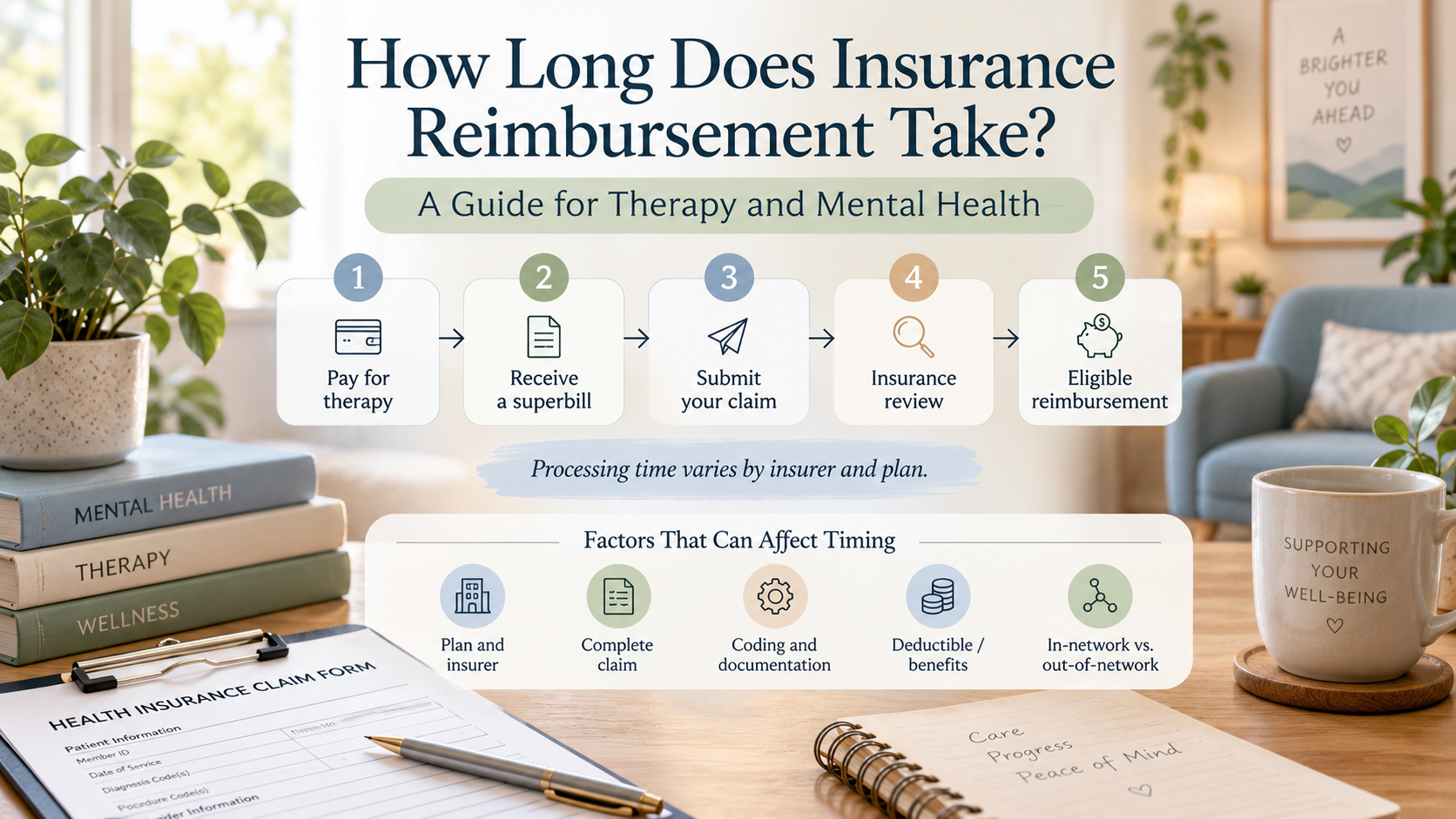
Out-of-network therapist → Pay therapist → Get superbill → Submit claim → Insurance processes claim → EOB → Reimbursement
If your plan does not provide applicable out-of-network benefits, you may have to pay the therapist’s full fee yourself.
Is an Out-of-Network Therapist Worth It?
It can be, depending on your circumstances.
Patients sometimes choose an out-of-network therapist because of:
- Specialized expertise
- Therapist availability
- Location
- Scheduling
- Therapeutic fit
- Treatment approach
- Language or cultural considerations
- Other personal preferences
The financial question is whether the therapist’s effective cost fits your budget after considering any insurance reimbursement.
Don’t compare therapists solely by their advertised fee.
Compare:
Session fee − expected insurance reimbursement = potential effective cost
And remember that reimbursement is dependent on your plan.
Why Are So Many Therapists Out of Network?
There are several possible reasons therapists choose not to participate in insurance networks.
These may include:
- Administrative burden
- Insurance reimbursement rates
- Documentation requirements
- Claim management
- Practice model
- Provider preferences
For a deeper explanation, read ++Why Don’t Therapists Take Insurance?++.
What If There Are No In-Network Therapists Available?
If your plan’s network doesn’t have a suitable therapist, ask your insurance company what options are available.
Depending on your plan and circumstances, there may be procedures for situations where appropriate in-network care isn’t reasonably available.
Don’t assume that an out-of-network exception or authorization is guaranteed.
Instead, ask your insurer:
“I haven’t been able to find an appropriate in-network mental health provider. What options does my plan provide for accessing an out-of-network therapist?”
Document the providers you’ve contacted and the responses you received if the insurer asks for that information.
How to Find an In-Network Therapist
A practical process is:
Step 1: Start with your insurance directory
Search for mental health providers in your area.
Step 2: Narrow your preferences
Consider:
- Specialty
- Location
- Availability
- Telehealth
- Language
- Treatment approach
Step 3: Contact the therapist
Ask whether they currently accept your specific plan.
Step 4: Verify with the insurer
Confirm that the provider is in network for your exact plan.
Step 5: Ask about your expected cost
Confirm:
- Copay
- Deductible
- Coinsurance
- Authorization requirements
Step 6: Confirm before the first appointment
Network status can change, so verify important information before beginning treatment.
How to Find an Out-of-Network Therapist You Can Afford
If your plan provides out-of-network benefits, you don’t necessarily need to limit your search to your insurer’s network directory.
Instead:
- Find therapists who meet your clinical needs.
- Ask for their session fees.
- Ask whether they provide superbills.
- Check whether your insurance provides out-of-network benefits.
- Ask the insurer how reimbursement is calculated.
- Estimate your effective cost.
- Compare providers.
For some patients, this creates a larger pool of therapists to consider.
What If My Therapist Is Out of Network and I Want to Use Insurance?
Start with these four questions:
1. Does my plan have out-of-network mental health benefits?
2. What is my out-of-network deductible?
3. How is reimbursement calculated?
4. What documentation do I need to submit a claim?
Then ask your therapist:
5. Do you provide superbills?
6. What is your full session fee?
7. Do you submit claims for patients?
With those answers, you can estimate the potential cost before committing to ongoing treatment.
In-Network or Out-of-Network: Which Is Better?
Neither is automatically better.
In-network may be preferable if:
- You want predictable cost-sharing.
- Your plan has favorable in-network benefits.
- You can find a therapist who meets your needs.
- You prefer the provider to handle insurance billing.
Out-of-network may be preferable if:
- You have strong out-of-network benefits.
- Your preferred therapist isn’t in network.
- You need a particular specialization.
- You value provider choice.
- The effective cost fits your budget.
The best choice depends on both your healthcare needs and your insurance benefits.
Quick Decision Guide
| If… | Consider… |
| Your preferred therapist is in network | Verify your copay/deductible and benefits |
| Your preferred therapist is out of network | Check out-of-network benefits |
| You don’t know your network status | Contact your insurer |
| Your plan has no out-of-network benefits | Compare in-network options or discuss other payment options |
| Your therapist provides superbills | Ask how you submit them |
| You pay upfront for out-of-network therapy | Confirm reimbursement before committing |
| Your therapist recently changed network status | Ask the insurer when the change became effective |
| You can’t find an appropriate in-network provider | Ask your insurer about available options |
Frequently Asked Questions
How do I know if my therapist is in network?
Check your insurer’s provider directory, ask your therapist, and confirm directly with your insurance company for your specific plan.
What does it mean if my therapist is out of network?
It generally means the therapist does not have a contracted relationship with your specific insurance plan. Your plan may still provide out-of-network benefits.
Does out of network mean insurance won’t pay?
No. Some insurance plans provide out-of-network benefits for eligible services.
Is my therapist out of network if they don’t file insurance?
Not necessarily. Whether a provider is in or out of network is a network-contract question, while who submits the claim is a billing-process question.
My therapist is out of network. What should I do?
Confirm your out-of-network benefits, ask about the therapist’s fee and superbill process, and find out how to submit claims to your insurer.
Can I get reimbursed for an out-of-network therapist?
Possibly. If your plan provides applicable out-of-network benefits, you may be able to receive reimbursement for eligible services.
What is an out-of-network therapist worth paying for?
That depends on the therapist’s fee, your insurance reimbursement, your budget, and how well the therapist meets your needs.
Can my therapist become in network?
A therapist can potentially pursue participation with an insurance network, but the process and requirements depend on the insurer and provider.
What if my therapist was in network and is now out of network?
Ask the insurer when the provider’s network status changed and how previously provided services are being handled. Then ask about your current out-of-network benefits.
Why are some therapists out of network?
Possible reasons include administrative workload, reimbursement rates, documentation requirements, and the therapist’s practice model.
How much does an out-of-network therapist cost?
There is no standard price. You may need to pay the therapist’s full fee upfront, with potential reimbursement depending on your insurance plan.
The Bottom Line
To find out whether your therapist is in or out of network, verify the provider’s status with your insurance company for your exact plan.
Don’t rely solely on a therapist’s website or the phrase “accepts insurance.”
If your therapist is in network, your plan may provide benefits with a copay, coinsurance, or deductible.
If your therapist is out of network, you may still be able to use insurance if your plan offers out-of-network benefits. You may pay the therapist directly, receive a superbill, submit a claim, and receive reimbursement if the service is eligible under your plan.
Before your first appointment, verify:
Network status → Coverage → Deductible → Copay/coinsurance → Out-of-network benefits → Claim requirements
That small amount of research can help prevent a much bigger surprise when your first insurance claim is processed.
Related DeputyCare Resources
Therapy insurance
- ++Is Therapy Covered by Insurance?++
- ++Does Health Insurance Cover Therapy?++
- ++What Is an Out-of-Network Provider?++
- ++Superbill Reimbursement: How Out-of-Network Therapy Works++
- ++How Much Does Insurance Pay for Therapy?++
- ++How Long Does Insurance Reimbursement Take?++
- ++Why Don’t Therapists Take Insurance?++
Superbill and claims
- ++Superbill for Therapists++
- ++Mental Health Superbill Template++
- ++How to Create a Superbill for Therapy++
- ++How to Submit Therapy Claims to Insurance++