How AI Is Transforming Therapy Superbill and Insurance Workflows
Managing a therapy practice involves far more than providing clinical care. Therapists and behavioral health practices also have to manage billing, insurance information, superbills, documentation, payments, scheduling, and patient communication.
As a practice grows, these administrative tasks can consume an increasing amount of time.
One area where this is especially noticeable is the therapy superbill and insurance workflow. Preparing documents, entering billing information, checking records, answering patient questions, and keeping administrative information organized can become repetitive.
Artificial intelligence (AI) is creating new opportunities to automate some of this work.
For therapy practices, the most useful role for AI may not be replacing clinical professionals. Instead, AI can act as an administrative assistant, helping organize information, identify missing data, automate repetitive processes, and surface tasks that need human attention.
In this guide, we’ll explain how AI is being used in healthcare administration, how AI can support therapy superbill and insurance workflows, what practices should consider before using AI, and where human oversight remains essential.
Quick answer: AI can help therapy practices streamline administrative workflows by organizing information, identifying missing or inconsistent data, preparing documents, automating repetitive tasks, and supporting insurance-related administration. AI should not replace professional judgment or be treated as an automatic authority for clinical, coding, billing, or insurance decisions.
What Is AI in Healthcare Administration?
AI in healthcare administration refers to the use of artificial intelligence technologies to assist with non-clinical processes such as documentation, scheduling, billing, data organization, communication, and other operational workflows.
AI can work with large amounts of structured and unstructured information much faster than a person performing the same repetitive task manually.
Common administrative applications include:
- Organizing information
- Extracting information from documents
- Identifying missing fields
- Summarizing records
- Categorizing administrative tasks
- Automating repetitive workflows
- Supporting scheduling
- Assisting with communications
- Identifying information that requires review
- Supporting revenue-cycle and billing workflows
The goal is not necessarily to automate an entire process.
In many healthcare applications, the better approach is to automate repetitive steps while keeping people responsible for decisions that require judgment.
What Is a Therapy Superbill?
A therapy superbill is an itemized document that summarizes healthcare services provided by a therapist or mental health professional.
Patients may use a superbill when requesting reimbursement from an insurance company for eligible out-of-network therapy services.
A superbill may contain information such as:
- Patient information
- Provider information
- Provider credentials
- National Provider Identifier (NPI)
- Date of service
- Type of service
- CPT or other procedure code
- Diagnosis information, when applicable
- Amount charged
- Amount paid
The exact information needed can vary based on the provider, service, payer, and insurance plan.
A superbill is also not the same thing as an insurance claim. It can provide information used by a patient or billing workflow when submitting an out-of-network reimbursement request.
For therapists who regularly provide superbills, maintaining accurate information is essential.
Why Therapy Superbills Create Administrative Work
Creating one superbill may be relatively simple.
Creating and managing hundreds of them is different.
A therapist or practice administrator may repeatedly need to:
- Gather patient information
- Confirm provider information
- Record dates of service
- Enter procedure and diagnosis information
- Record charges and payments
- Check for missing information
- Generate the document
- Send it to the patient
- Store the record
- Respond to questions
- Correct errors when information changes
When these tasks are handled manually, small amounts of administrative work can accumulate into hours of work over time.
This is where automation can have a meaningful impact.
How Can AI Help With Therapy Superbills?
AI can potentially support several parts of a therapy superbill workflow.
For example, an AI-powered administrative system could help:
Organize information
Relevant patient, provider, appointment, and billing information can be brought together into a consistent workflow.
Identify missing information
AI can flag fields that appear incomplete or inconsistent before a document is finalized.
Reduce repetitive data entry
Information that already exists elsewhere in a workflow may not need to be manually re-entered.
Assist with document preparation
Software can use existing information to help prepare administrative documents.
Surface exceptions
Instead of requiring staff to manually inspect every routine record, an automated system can identify items that appear unusual or incomplete and send them for review.
Support administrative follow-up
AI can also help organize tasks that require follow-up, reducing the chance that routine administrative work gets lost.
The important point is that AI assistance does not eliminate the need for review.
A useful workflow is:
Collect → Organize → Check → Human Review → Finalize
AI and Therapy Insurance Workflows
Superbills are only one part of the broader insurance administration process.
Depending on the practice and payer, insurance-related workflows may involve:
- Collecting patient information
- Verifying insurance details
- Recording services
- Preparing documentation
- Creating superbills
- Submitting claims
- Tracking claim status
- Identifying rejected or incomplete information
- Following up on outstanding items
- Maintaining billing records
AI can potentially assist with some of these repetitive administrative activities.
For example, an AI-enabled system might help identify information that appears to be missing before an administrative record moves to the next stage.
It could also help categorize work into areas such as:
Ready → Needs Review → Missing Information → Follow Up
That kind of workflow can help administrative teams focus their attention where it is actually needed.
However, insurance coverage and reimbursement decisions ultimately depend on the relevant payer, plan, claim, and applicable requirements.
AI should not be treated as a guarantee of insurance coverage or reimbursement.
Can AI Create a Therapy Superbill?
AI-powered software can potentially assist with preparing a therapy superbill by organizing information and reducing repetitive data entry.
However, there is an important distinction between assisting with a superbill and determining that the superbill is correct.
A system may be able to populate information, identify missing fields, or generate a draft.
A qualified person should still review important information before the document is finalized.
For example, a practice should verify information such as:
- Patient identity
- Provider information
- Date of service
- Procedure code
- Diagnosis information
- Charge
- Payment
- Any payer-specific requirements
A useful principle is:
Automate the preparation. Keep humans responsible for verification.
AI for Mental Health Billing
AI can also play a role in broader mental health billing workflows.
Billing administration can involve large amounts of repetitive information, including appointments, patient records, payments, service details, and insurance-related data.
Potential AI-assisted workflows include:
- Organizing billing information
- Identifying incomplete records
- Flagging inconsistent information
- Automating routine administrative tasks
- Categorizing billing-related work
- Assisting with payment and account workflows
- Prioritizing tasks requiring attention
- Reducing duplicate data entry
This doesn’t mean AI should independently determine how a service should be coded or whether a claim should be submitted.
Instead, AI can help make the administrative process around billing more efficient.
AI for Healthcare Administration: A Practical Example
Consider a therapist who sees 30 patients each week.
After each appointment, administrative work may include updating records, recording payments, preparing documentation, answering questions, and handling insurance-related tasks.
Even if each task only takes a few minutes, the cumulative workload can be substantial.
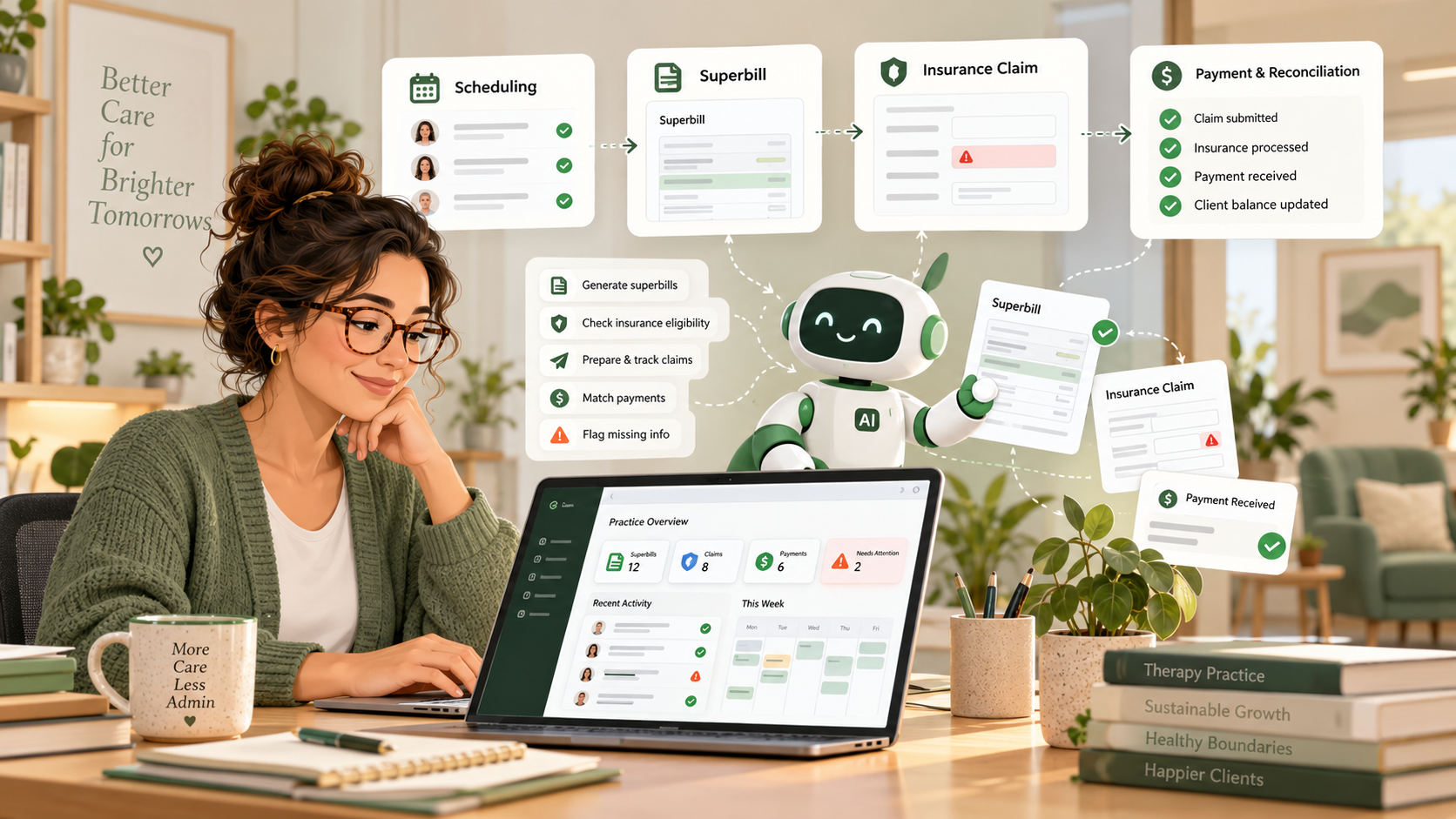
A more automated workflow could look like this:
Step 1: Capture
Appointment and billing information enters the practice workflow.
Step 2: Organize
The system connects relevant information and places it into the appropriate administrative records.
Step 3: Check
Automated rules or AI identify information that appears incomplete or inconsistent.
Step 4: Flag exceptions
Items requiring attention are separated from routine records.
Step 5: Human review
A therapist, administrator, or other appropriate professional reviews important information.
Step 6: Finalize
The approved document or administrative action is completed.
This approach is more realistic than trying to automate everything.
AI Should Support Therapists, Not Replace Them
The most valuable use of AI in a therapy practice may be the work that happens around therapy rather than the therapeutic relationship itself.
Therapy relies on:
- Human connection
- Empathy
- Clinical expertise
- Communication
- Professional judgment
- Context
- Trust
Administrative workflows have different characteristics.
They often involve repetitive processes that can be standardized or assisted by technology.
That creates an opportunity for AI to reduce administrative friction without attempting to replace the therapist.
The goal should be simple:
Let technology handle more repetitive administrative work so therapists can spend more time on work that requires human expertise.
What Are the Risks of Using AI in Healthcare Administration?
AI can be useful, but healthcare organizations need to approach implementation carefully.
Potential concerns include:
Privacy
Healthcare information can contain highly sensitive personal and health information.
Practices need to understand how a technology handles, stores, transmits, and protects sensitive data.
Accuracy
AI systems can produce incorrect or incomplete information.
Important administrative information should therefore be reviewed before it is finalized.
Security
Organizations should evaluate security controls, access management, data handling, and other safeguards provided by the technology.
Over-automation
Not every administrative decision should be automated.
Tasks involving significant consequences may require human review.
Regulatory requirements
Healthcare practices need to consider applicable federal, state, payer, professional, and organizational requirements.
For example, the U.S. Department of Health & Human Services (HHS) provides guidance and resources concerning HIPAA and the protection of health information.
Practices should evaluate the specific compliance requirements that apply to their organization and the technology they use.
Is AI HIPAA Compliant?
There is no blanket rule that says an AI tool is simply “HIPAA compliant” in every context.
Whether a particular AI implementation can be used appropriately in a healthcare environment depends on factors including:
- What information is being processed
- How the information is stored
- How information is transmitted
- Who can access it
- What contractual protections are in place
- Whether a Business Associate Agreement (BAA) is required
- How the organization configures and uses the technology
The HIPAA Privacy Rule establishes national standards for protecting certain health information, while the HIPAA Security Rule addresses safeguards for electronic protected health information.
Healthcare organizations should evaluate the specific technology and workflow rather than relying solely on a marketing claim about AI or HIPAA.
External resource: ++U.S. Department of Health & Human Services — HIPAA for Professionals++
How to Implement AI Safely in a Therapy Practice
A therapy practice doesn’t need to automate everything at once.
A practical implementation strategy is to start with repetitive, low-risk administrative tasks.
1. Identify repetitive work
List the administrative processes your team performs repeatedly.
Examples include:
- Data entry
- Document preparation
- Billing administration
- Superbill workflows
- Appointment administration
- Follow-up tasks
2. Identify where mistakes occur
Look for areas where missing or inconsistent information creates additional work.
3. Start with assistance, not full automation
Use AI to flag, organize, summarize, or prepare information before allowing it to take consequential actions.
4. Establish human review
Determine which tasks require approval before completion.
5. Monitor results
Track whether automation actually reduces workload, errors, and administrative delays.
6. Expand gradually
Once a workflow is working reliably, consider applying automation to additional processes.
AI and the Future of Therapy Practice Management
The broader trend isn’t simply “AI replacing healthcare workers.”
It is the movement toward more intelligent healthcare administration.
Practice-management systems are increasingly expected to do more than store appointments and billing records.
The next generation of tools can potentially:
- Connect information across workflows
- Reduce repetitive data entry
- Detect exceptions
- Automate routine processes
- Surface tasks requiring attention
- Help practices operate more efficiently
For therapy practices, this can be especially valuable because administrative workload tends to increase as the number of patients and appointments grows.
A practice that sees 10 patients a week may manage administrative work manually.
A practice seeing hundreds of appointments a month needs systems that can scale.
AI, Superbills, and Out-of-Network Therapy
AI-powered administration is particularly relevant to practices that work with out-of-network patients.
When patients pay for therapy directly and seek reimbursement from their insurance company, practices may need to manage superbills and related administrative information.
A streamlined workflow could help practices:
Track appointments → Record payments → Prepare superbill information → Check completeness → Review → Deliver to patient
The patient can then follow the insurer’s process for submitting an out-of-network reimbursement claim.
Because insurance plans differ, practices should avoid assuming that one workflow or document will meet every payer’s requirements.
How AI Can Save Therapists Time
The biggest benefit of administrative AI may not come from one dramatic automation.
It can come from eliminating dozens of small repetitive tasks.
Consider:
- Copying patient information
- Re-entering provider details
- Checking documents
- Organizing billing records
- Preparing routine documents
- Tracking follow-up items
- Searching for information
- Identifying incomplete records
Each task may seem insignificant.
Together, they can represent a substantial administrative workload.
The opportunity with AI is to reduce that friction while keeping humans in control of important decisions.
What Should Therapists Look for in AI Billing Software?
If you’re evaluating AI-powered billing or practice-management software, don’t focus only on whether the product says it uses AI.
Look at the actual workflow.
Questions worth asking include:
Does it reduce manual data entry?
AI should solve a real administrative problem rather than simply add another layer of technology.
Can it identify missing information?
The ability to flag incomplete records can be more valuable than simply generating text.
Is there human review?
Important healthcare and billing workflows should have appropriate review mechanisms.
How is sensitive information handled?
Understand data storage, access, security, retention, and contractual arrangements.
Does it fit existing workflows?
Technology should make administration easier rather than requiring staff to maintain another disconnected system.
Can it scale?
A workflow that works for a small practice should ideally remain manageable as the practice grows.
How DeputyCare Can Help With Therapy Administration
DeputyCare focuses on simplifying healthcare administration around billing, insurance, superbills, and automation.
For therapists, the value of automation isn’t simply generating documents faster.
It’s creating a workflow where information can move through the administrative process with less repetitive manual work.
The ideal workflow is:
Capture → Organize → Automate → Check → Review → Complete
That approach can help practices reduce administrative friction while preserving human oversight.
For practices looking to modernize their billing and insurance workflows, AI can become one component of a broader administrative system.
Frequently Asked Questions About AI in Therapy Administration
How is AI used in healthcare administration?
AI can assist with administrative tasks such as information organization, document processing, scheduling, communication, billing workflows, data review, and identifying incomplete or inconsistent information.
Its specific capabilities depend on the software and how the organization implements it.
How can AI help therapists?
AI can help therapists and practice staff reduce repetitive administrative work, organize information, prepare documents, identify missing data, and manage routine workflows.
AI should complement professional judgment rather than replace it.
Can AI create a therapy superbill?
AI-powered software can potentially assist with preparing a therapy superbill by organizing information and reducing manual data entry.
Important information should be reviewed for accuracy before a superbill is finalized or provided to a patient.
Can AI submit insurance claims?
Some software may automate or assist with portions of an insurance workflow, but practices should understand exactly what the technology does and maintain appropriate review and controls.
AI does not guarantee that an insurance claim will be accepted or reimbursed.
Can AI help with mental health billing?
Yes. AI can potentially assist with repetitive billing administration, information organization, identifying incomplete records, document preparation, and other workflow tasks.
The exact capabilities depend on the billing system.
Is AI replacing therapists?
AI is not a replacement for the human relationship, empathy, clinical expertise, and professional judgment involved in therapy.
Its administrative role is better understood as assisting professionals with repetitive tasks.
Is AI safe for healthcare administration?
AI can be used responsibly when practices implement appropriate privacy, security, access controls, accuracy checks, and human oversight.
Organizations should evaluate the specific technology and workflow before using it with sensitive healthcare information.
Is AI HIPAA compliant?
AI itself is not automatically HIPAA compliant or non-compliant.
Healthcare organizations need to evaluate how a specific technology handles protected health information and whether appropriate safeguards, agreements, and configurations are in place.
See the ++HHS HIPAA resources++ for official information.
Will AI reduce administrative work for therapists?
It can.
The greatest opportunity may come from automating repetitive tasks such as information entry, document preparation, record organization, and workflow management.
The actual time savings depend on the practice, software, and implementation.
Final Thoughts
AI is changing healthcare administration, but the most useful applications may be less dramatic than the headlines suggest.
For therapy practices, AI can help with the repetitive work that surrounds patient care: billing, superbills, insurance administration, information organization, documentation workflows, and follow-up tasks.
The goal shouldn’t be to automate everything.
Instead, practices should identify repetitive processes, automate appropriate steps, build in human review, and protect sensitive patient information.
For a growing therapy practice, that can mean less time spent on administrative friction and more time available for higher-value work.
AI won’t replace the therapist.
Used thoughtfully, it can help make the administrative side of running a therapy practice more efficient, organized, and scalable.
Related DeputyCare Resources
- ++Superbill for Therapists: Complete Guide++
- Mental Health Superbill Template: What to Include + Free Example
- How to Create a Superbill for Therapy
- How to Submit a Superbill to Insurance
- Why Don’t Therapists Take Insurance?
- Out-of-Network Reimbursement for Therapy
- Superbill vs. Insurance Claim
Sources & Further Reading
- ++U.S. Department of Health & Human Services — HIPAA for Professionals++
- ++HHS — Summary of the HIPAA Security Rule++
- ++CMS — Medicare Claims Processing Manual++
- ++CDC — ICD-10-CM Official Guidelines for Coding and Reporting++
This article is for educational purposes and does not constitute medical, legal, coding, insurance, or compliance advice. Healthcare organizations should evaluate their specific requirements and consult qualified professionals when necessary.