An out-of-network provider is a healthcare professional or facility that does not have a contracted agreement with your health insurance plan.
For therapy, an out-of-network provider may be a therapist who does not participate in your insurance company’s network.
That does not always mean insurance will pay nothing.
Some health insurance plans provide out-of-network benefits, which may allow you to receive partial reimbursement for eligible services. Other plans may provide little or no coverage for routine out-of-network care.
Quick answer: An out-of-network provider is a healthcare provider who does not have a contracted network agreement with your health insurance plan. Depending on your plan, you may still have out-of-network benefits, but you may pay more and may need to submit the claim yourself for reimbursement.
What Does “Out of Network” Mean?
Health insurance companies create networks of healthcare providers who agree to participate in their plans under specific contractual terms.
A provider who participates in your plan’s network is an in-network provider.
A provider who does not participate in that network is generally considered out of network.
The distinction matters because your insurance plan can apply different cost-sharing and reimbursement rules depending on whether a provider is in or out of network.
Simple example
Suppose you have a health insurance plan and want to see a therapist.
You find:
- Therapist A: In network with your plan
- Therapist B: Out of network with your plan
You may have different financial responsibilities for the same type of therapy service depending on which therapist you choose.
Your plan might have:
- Different deductibles
- Different coinsurance
- Different copay rules
- Different allowed amounts
- Different reimbursement rules
The exact difference depends on your insurance plan.
What Is the Difference Between In-Network and Out-of-Network Providers?
The biggest difference is the provider’s relationship with your insurance plan.
| In-network provider | Out-of-network provider |
| Has a network agreement with the insurer | Does not have a network agreement with that plan |
| Generally subject to contracted terms | Generally not subject to the plan’s in-network contracted rate |
| Usually uses in-network benefits | May use out-of-network benefits if the plan offers them |
| Provider often submits the claim | Patient may need to submit the claim |
| Patient costs may be lower | Patient costs may be higher |
| Billing process is often handled by the practice | Patient may receive documentation such as a superbill |
These are general differences. Your specific plan and provider determine how the billing arrangement actually works.
Can You Use Insurance With an Out-of-Network Provider?
Sometimes.
Being out of network does not automatically mean that insurance will not contribute toward the cost of care.
The key question is:
Does your health insurance plan provide out-of-network benefits for this service?
For example, some plans may provide out-of-network mental health benefits, while others may limit or exclude routine out-of-network care.
Before scheduling therapy with an out-of-network provider, check your plan’s benefits.
Ask your insurance company:
- Does my plan cover out-of-network therapy?
- What is my out-of-network deductible?
- What is my out-of-network coinsurance?
- Is there an out-of-network allowed amount?
- Is my therapist eligible for reimbursement?
- Do I need prior authorization?
- Do I need a referral?
- Do I submit the claim or does the therapist?
- What documentation is required?
- Is there a filing deadline?
Getting these answers before your first appointment can prevent unexpected costs.
What Is an Out-of-Network Provider for Therapy?
For therapy, an out-of-network provider is generally a therapist or mental health professional who does not participate in your specific insurance network.
You may choose an out-of-network therapist because:
- You prefer their specialty.
- Their location is more convenient.
- They have availability sooner.
- You were referred to them.
- You prefer their approach to therapy.
- You want to continue seeing an existing therapist.
- There are limited in-network options in your area.
Choosing an out-of-network therapist can give you more provider options, but you should understand your insurance benefits first.
Does Insurance Cover Out-of-Network Therapy?
It depends on your plan.
Some health insurance plans offer out-of-network mental health benefits. Others may not.
Even when out-of-network therapy is covered, the reimbursement may be different from what you would receive for an in-network provider.
Your plan may apply:
- A separate deductible
- A different coinsurance percentage
- A different allowed amount
- Different claim rules
- Different annual limits or requirements
Do not assume that an out-of-network therapist will be reimbursed at the same rate as an in-network therapist.
For more information, see:
++How Much Does Insurance Pay for Therapy?++
Why Does Out-of-Network Therapy Cost More?
Out-of-network care can cost more for several reasons.
Your plan may require you to pay:
- A larger deductible
- A higher coinsurance percentage
- The difference between the provider’s fee and the insurer’s allowed amount
- Other costs that your plan does not cover
Consider a simplified example.
A therapist charges $180 for a session.
Your insurance plan may determine that its allowed amount for the service is lower than the therapist’s charge.
Your plan may then calculate reimbursement based on its out-of-network rules.
The result could be different from simply receiving a percentage of the therapist’s $180 fee.
This is why patients should ask about the allowed amount, not just the reimbursement percentage.
What Is an Out-of-Network Deductible?
A deductible is the amount you may have to pay for covered services before your insurance begins paying according to the plan’s applicable cost-sharing rules.
An out-of-network deductible may be separate from your in-network deductible.
For example, your plan could have different rules for:
- In-network deductible
- Out-of-network deductible
- In-network coinsurance
- Out-of-network coinsurance
The exact structure varies by plan.
Check your Summary of Benefits and Coverage and your insurer’s member information for the rules that apply to you.
What Is Out-of-Network Reimbursement?
Out-of-network reimbursement is the amount your health insurance plan pays toward an eligible service received from a provider who is outside the plan’s network.
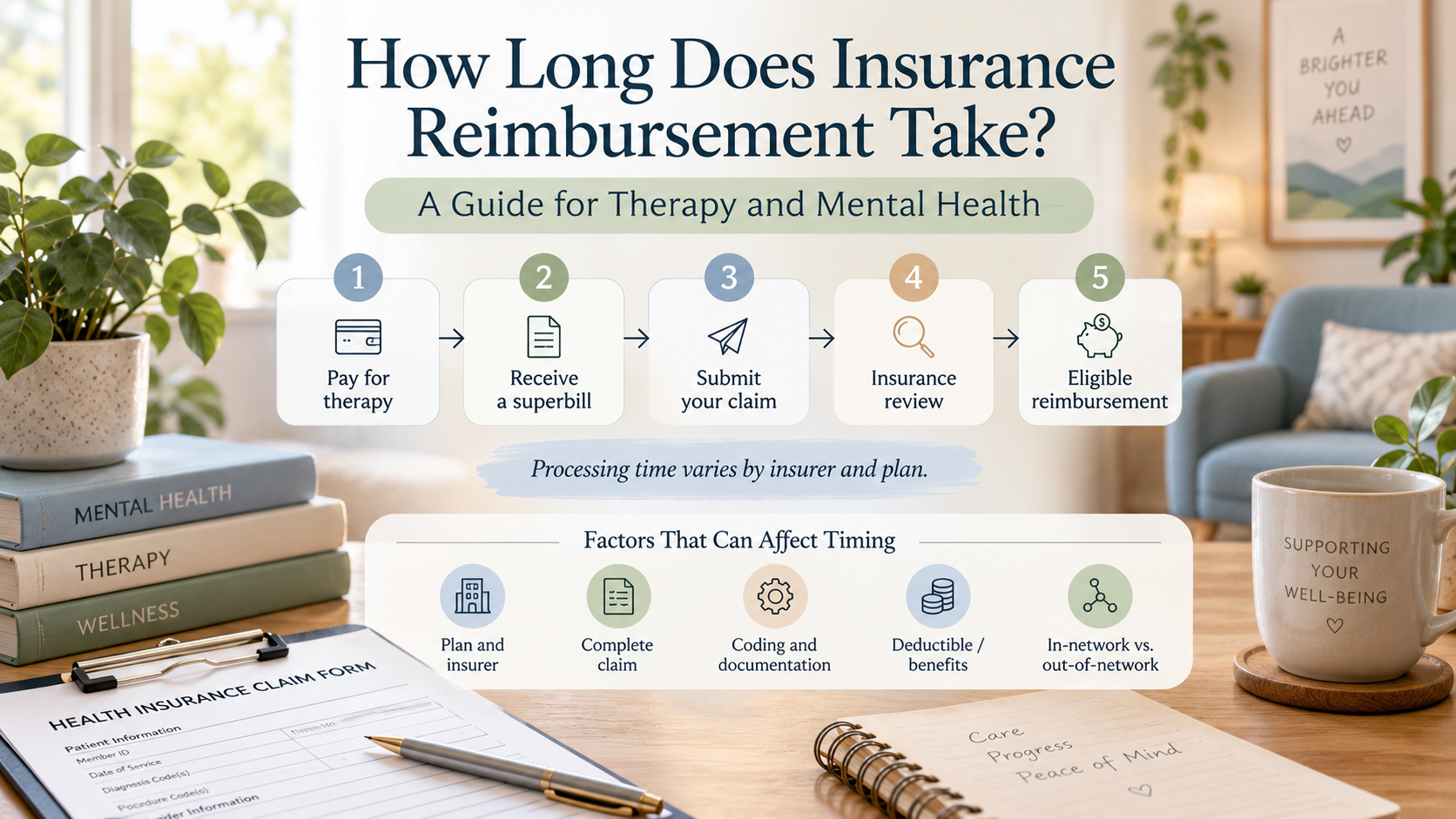
For therapy, a common reimbursement process may look like:
Patient sees therapist → Patient pays therapist → Patient receives documentation → Patient submits claim → Insurer processes claim → Patient receives eligible reimbursement
The amount reimbursed depends on the plan.
It may be affected by:
- Deductible
- Coinsurance
- Allowed amount
- Service eligibility
- Provider status
- Claim requirements
Reimbursement is not guaranteed simply because a provider is licensed or because a service is medically related.
What Is a Superbill?
A superbill is a healthcare billing document that summarizes services provided to a patient.
Patients may receive a superbill from an out-of-network therapist and use it when submitting a reimbursement claim.
A superbill may include information such as:
- Provider name
- Provider address
- NPI
- Patient information
- Date of service
- Service or procedure information
- Diagnosis information, when applicable
- Amount charged
- Amount paid
The exact information required depends on the payer.
A superbill does not guarantee reimbursement.
The insurance company determines whether the service is eligible and how the claim is handled under the patient’s plan.
Learn more:
- ++Superbill for Therapists++
- ++Mental Health Superbill Template++
- ++How to Create a Superbill for Therapy++
How Do You Submit an Out-of-Network Therapy Claim?
If your plan requires you to submit your own claim, the process commonly looks like this:
1. Verify your benefits
Confirm that out-of-network therapy is covered.
2. Ask your therapist for documentation
Your therapist may provide a superbill or other documentation.
3. Get your insurer’s claim instructions
Your insurer may allow online, app-based, electronic, or paper submissions.
4. Complete the claim
Provide the information requested by your insurer.
5. Attach supporting documentation
Include the superbill or other required documents.
6. Submit the claim
Use the method specified by your insurer.
7. Save your confirmation
Keep the claim number and submission information.
8. Track the claim
Check your insurance portal or contact member services.
9. Review your EOB
Your Explanation of Benefits should show how the claim was processed.
For a detailed walkthrough, see:
++How to Submit Therapy Claims to Insurance++
How Long Does Out-of-Network Insurance Reimbursement Take?
There is no universal reimbursement timeline.
The timeframe depends on:
- Insurance company
- Specific plan
- Claim submission method
- Whether the claim is complete
- Whether additional information is required
- Claim complexity
- Payment method
If you have submitted a claim, check your insurer’s portal or contact member services to ask about the expected processing time.
For more information:
++How Long Does Insurance Reimbursement Take?++
Does an Out-of-Network Provider Submit Claims?
It depends on the provider and billing arrangement.
Some out-of-network providers may submit claims on behalf of patients.
Others may operate on a self-pay model in which the patient pays the provider and submits the claim independently.
Before your first appointment, ask the provider:
“Do you submit insurance claims for out-of-network patients, or will I need to submit the claim myself?”
If you need to submit the claim yourself, ask what documentation the provider will provide.
What Is the Difference Between Out-of-Network and Self-Pay?
These terms are related but not identical.
Out of network
The provider does not participate in your specific insurance network.
You may still have insurance benefits that apply.
Self-pay
You pay the provider directly rather than having the provider bill your insurance as part of the visit.
A patient can sometimes self-pay an out-of-network provider and then submit a claim for potential reimbursement.
Whether that is permitted and how it works depends on the insurance plan.
Can an Out-of-Network Provider Be Covered at In-Network Rates?
Sometimes, depending on the circumstances and the plan.
Certain situations may result in different benefit treatment, but you should not assume that an out-of-network provider automatically receives in-network benefits.
If you believe a provider should be treated as in network for a particular situation, contact your insurer and ask how the claim will be processed.
For specific protections involving emergency services and certain other circumstances, consult your plan documents and authoritative government guidance.
What Happens If You See an Out-of-Network Provider Without Checking?
You may discover that:
- Your plan does not provide out-of-network benefits.
- Your deductible is higher than expected.
- The insurer’s allowed amount is lower than the provider’s fee.
- You are responsible for a larger share of the cost.
- You need to submit the claim yourself.
- The claim requires additional documentation.
- The service is subject to authorization or other plan requirements.
The safest approach is to verify your benefits before receiving care.
How Can You Find Out Whether a Therapist Is In Network?
You can check in several ways.
Use your insurance company’s provider directory
Search for the therapist by:
- Name
- Location
- Specialty
- Provider type
Ask the therapist
The practice may be able to tell you which insurance plans it participates in.
Confirm with your insurer
This is especially important because provider-network information can change.
Ask the insurer to verify the provider’s network status for your specific plan, not simply the insurance company’s brand.
For example, a therapist may participate in one plan offered by an insurer but not another.
Why Might a Therapist Choose to Be Out of Network?
There are many reasons a therapist may not participate in a particular insurance network.
A therapist may prefer:
- More control over scheduling
- Fewer insurance-related administrative requirements
- Greater flexibility in practice operations
- A specific fee structure
- More time for clinical work
- Less reliance on insurance reimbursement
This does not necessarily mean the therapist refuses to work with patients who have insurance.
A therapist may still provide superbills for eligible out-of-network reimbursement.
For a deeper discussion, see:
++Why Don’t Therapists Take Insurance?++
What Are the Pros and Cons of Seeing an Out-of-Network Therapist?
Potential advantages
More provider choice
You may have access to therapists who are not available within your insurance network.
Greater specialization
You may find a therapist with experience in a particular condition, population, or therapeutic approach.
More flexibility
Some providers may have different scheduling or practice structures than in-network practices.
Potential reimbursement
If your plan offers out-of-network benefits, you may be able to receive reimbursement for eligible services.
Potential disadvantages
Higher upfront costs
You may have to pay the therapist directly.
Higher deductible
Your out-of-network deductible may be higher or separate from your in-network deductible.
More paperwork
You may have to submit your own claims.
Uncertain reimbursement
Coverage and reimbursement depend on your plan.
More administrative responsibility
You may need to manage superbills, claim submissions, EOBs, and follow-up.
Out-of-Network Therapy: Example
Imagine you choose an out-of-network therapist who charges $175 per session.
Before your first visit, you confirm that your plan offers out-of-network mental health benefits.
After the appointment:
You pay the therapist $175
↓
The therapist provides the required documentation
↓
You submit an out-of-network claim
↓
The insurer processes the claim
↓
The insurer determines the allowed amount and applies your plan’s benefits
↓
You receive an EOB
↓
You receive any eligible reimbursement according to your plan
The actual reimbursement amount will depend on your insurance benefits.
The $175 provider charge does not automatically equal the amount used to calculate your reimbursement.
Is an Out-of-Network Provider Bad?
No.
“Out of network” describes the provider’s relationship with a particular insurance plan. It does not describe the quality of the provider.
An out-of-network therapist may be an excellent choice for a patient who values a particular specialty, therapeutic approach, availability, or provider relationship.
The important question is whether the financial arrangement works for you.
Before choosing an out-of-network provider, understand:
- Your coverage
- Your deductible
- Your coinsurance
- Your reimbursement rules
- Your provider’s fee
- Your claim responsibilities
Frequently Asked Questions
What is an out-of-network provider?
An out-of-network provider is a healthcare professional or facility that does not have a contracted network agreement with your specific health insurance plan.
What does it mean when a provider is out of network?
It means the provider does not participate in your plan’s network. Your insurance may apply different benefits to the service, and your out-of-pocket costs may be higher.
Can I use insurance with an out-of-network provider?
Sometimes. If your plan provides out-of-network benefits, you may be eligible for partial reimbursement. Check your specific plan before receiving care.
What is an out-of-network provider in medical billing?
In medical billing, an out-of-network provider is a provider who does not participate in the patient’s specific insurance network. Claims may be processed under out-of-network benefits, if available.
Is an out-of-network provider covered by insurance?
Not necessarily. Some plans provide out-of-network benefits, while others may provide little or no routine out-of-network coverage.
Can I get reimbursed for an out-of-network therapist?
Potentially. If your plan offers out-of-network mental health benefits and the service is eligible, you may be able to receive reimbursement according to the plan’s rules.
Do out-of-network providers cost more?
They can. Patients may face higher deductibles, coinsurance, or other out-of-pocket costs, depending on their plan.
Do I need a superbill for an out-of-network therapist?
You may. Some insurers require a superbill or similar documentation when a patient submits an out-of-network claim. Always follow your insurer’s specific requirements.
Who submits an out-of-network claim?
It depends on the billing arrangement. The provider may submit the claim, or the patient may be responsible for submitting it.
How do I know if my therapist is out of network?
Check your insurer’s provider directory, ask the therapist, and confirm with your insurance company for your specific plan.
Is out of network the same as self-pay?
No. Out of network describes the provider’s relationship with the insurance plan. Self-pay describes how the service is paid. An out-of-network patient may pay the provider directly and then request reimbursement.
Final Takeaway
An out-of-network provider is a healthcare provider who does not have a contracted relationship with your specific health insurance plan.
For therapy, seeing an out-of-network provider can still be a viable option if your plan offers out-of-network mental health benefits.
The key steps are:
Check benefits → Confirm provider status → Understand your costs → Ask about documentation → Submit claims when required → Track reimbursement
The most important thing is to verify your benefits before receiving care. Your insurance company’s rules—not a generic reimbursement percentage—determine whether and how much you may be reimbursed.
For therapists, a clear and organized process for patient information, billing, superbills, and insurance documentation can make out-of-network administration easier for both the practice and its patients.
Related DeputyCare Resources
- ++Superbill for Therapists++
- ++Mental Health Superbill Template++
- ++How to Create a Superbill for Therapy++
- ++How to Submit Therapy Claims to Insurance++
- ++How Long Does Insurance Reimbursement Take?++
- ++How Much Does Insurance Pay for Therapy?++
- ++Why Don’t Therapists Take Insurance?++
- ++How AI Is Transforming Therapy Superbill and Insurance Workflows++
Authoritative Resources
- ++HealthCare.gov++
- ++U.S. Department of Labor — Mental Health Parity++
- ++CMS — ICD-10 Codes++
- ++CDC — ICD-10-CM++
- ++HHS — HIPAA for Professionals++